International Schools in Chiang Mai vs Online Homeschooling: Cost and Fit
We compare the published 2026-27 fee schedules of five Chiang Mai international schools against the cost of studying the same curriculum from home, covering tuition, hidden first-year costs, withdrawal terms, and what each route actually costs a family.
 By Fabrizio Bestoso · · 18 min read
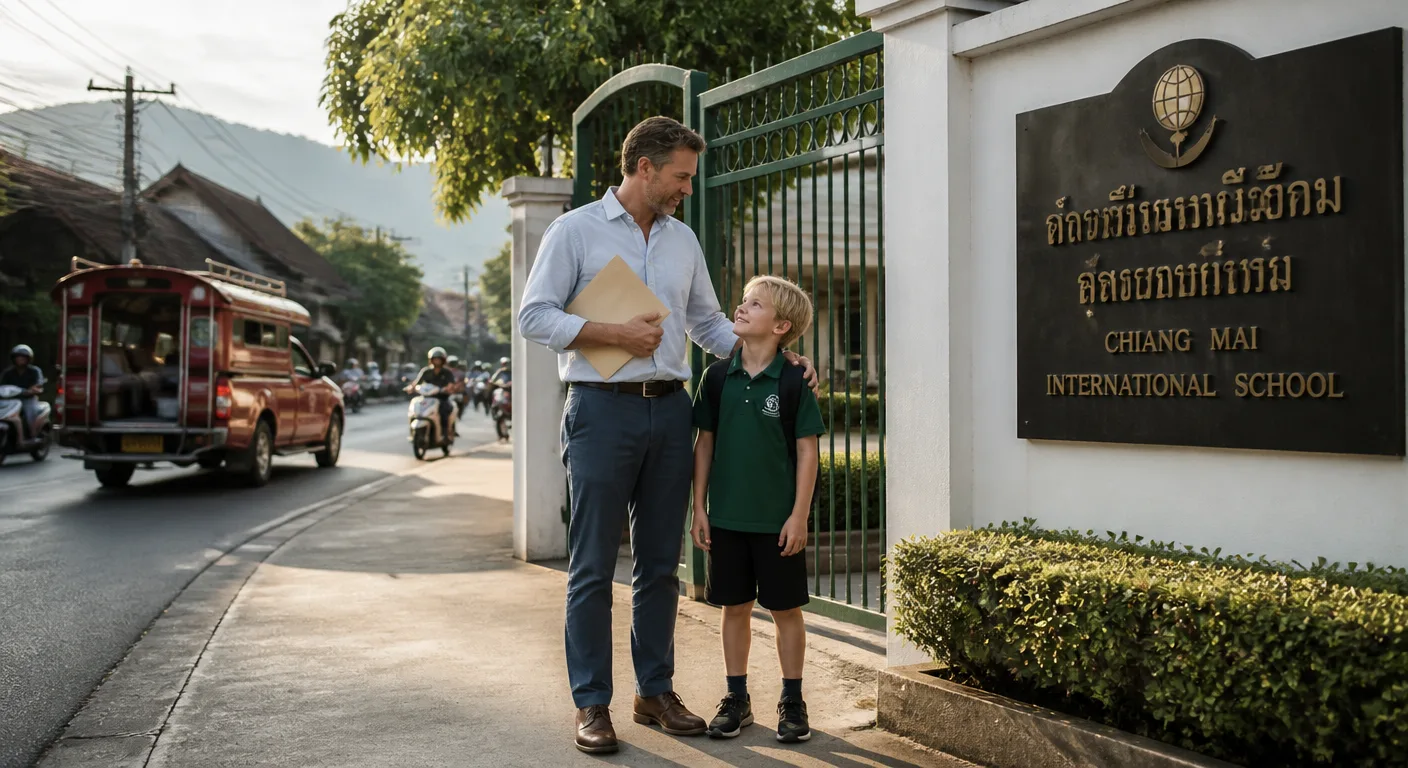
A family that has just signed a lease in Chiang Mai and starts pricing schools usually ends up with five browser tabs open in five different formats: one clean fee page, one PDF buried three clicks deep, one page that lists tuition but not lunch, another that lists lunch but not textbooks. None of the five numbers sit next to each other anywhere, and none of them say what the same family would pay to keep the child out of the classroom and taught from the kitchen table instead. This guide puts the international schools in Chiang Mai and the online alternative on the same page, in the same currency, for the same academic year.
We have not enrolled a child in, visited, or spoken with any of the five Chiang Mai international schools named below. Every fee, inclusion, and policy comes from that school's own published 2026-27 schedule, read and checked in September 2026 — not from attending one. What we do have direct experience of is the other side of the comparison: our own children have been through online distance schooling with a British-curriculum provider, and before that spent four years enrolled in two brick-and-mortar international schools abroad. That history shapes how we read a fee schedule, but it doesn't make us qualified to describe what any Chiang Mai school is like day to day, and we don't try to.
A few things worth knowing before the detail:
- Published 2026-27 tuition across the five schools compared here runs from 309,000 THB (Grace, Grades K-5) to 594,000 THB a year (Panyaden, IB Diploma years).
- Four of the five schools charge a one-time admission or enrollment fee of 75,000 to 150,000 THB on top of tuition, due before the child starts.
- The same headline tuition number buys different things: some schools bundle lunch, materials, and trips; others itemize none of them.
- Studying the same curriculum from home through an online British-curriculum school costs a fraction of one term's Chiang Mai tuition in cash — but shifts daily supervision onto a parent.
- The deposit, notice, and prepayment clauses in each contract, not the tuition line, decide whether a school actually fits a family that might leave mid-year.
How we compared them
We built this comparison from each school's own published 2026-27 fee schedule, read directly on its website or fee PDF, using a Year 7 / Grade 7 child as a single worked example across all five schools so the numbers describe the same age group and the same academic year.
The method, in short:
- We used only each school's own 2026-27 published fee schedule — not third-party directories, not forum quotes.
- We picked a Year 7 / Grade 7 child as the worked example, so every school's figure describes the same age band and year.
- We counted non-refundable one-time fees (application, admission, enrollment) into the first-year total, and listed refundable deposits separately, because a deposit is held, not spent.
- We priced everything in Thai baht first, with an approximate US-dollar figure at roughly 35 THB to the dollar, since exchange rates move and the baht number is the one printed in each contract.
- We did not visit, apply to, or speak with any of the five schools beyond what each publishes. This comparison is desk research from published schedules and from what parents discuss in local groups, not first-hand attendance.
What five Chiang Mai international schools charge in 2026-27
As of September 2026, published annual tuition at the five Chiang Mai international schools compared here runs from 309,000 THB at Grace's lower grades to 594,000 THB at Panyaden's IB Diploma years, before any admission fee, deposit, or extra is added. That range is about as close as a single answer for Chiang Mai international school fees can honestly get before a specific grade and its extras are added in.
| School | Curriculum or accreditation (as the school states it) | Tuition, Grade 7 / Year 7 (THB/year) | Range across grades (THB/year) | Included in tuition |
|---|---|---|---|---|
| SBS International School Chiangmai | Cambridge Pathway from Early Years to AS/A Levels; WASC and ONESQA | 319,300 THB (~$9,120) | 217,900–370,300 THB (~$6,230–$10,580) | Lunch, daily snack, visa application documents, accident insurance, field trips in selected years; not textbooks, uniforms, or Cambridge exam fees |
| Grace International School | American curriculum, biblical worldview; ACSI, WASC, ONESQA | 338,000 THB (~$9,660), Grades 6-8 band | 309,000–379,000 THB (~$8,830–$10,830) | Tuition only; entrance and capitalization fees are invoiced separately after acceptance |
| Chiang Mai International School | Not stated on the pages read; WASC accreditation shown | 463,400 THB (~$13,240), Grades 6-8 | 341,700–580,200 THB (~$9,760–$16,580) | Not itemized on the fee page; bus and lunch are not listed |
| Panyaden International School | British curriculum, IB Diploma, Thai national curriculum; WASC | 470,000 THB (~$13,430), Years 7-9 | 321,000–594,000 THB (~$9,170–$16,970) | Learning materials and textbooks, meals and snacks, most day and overnight trips, group accident policy |
| SISB Chiang Mai | Singapore, British, and IB frameworks (school-wide statement, not campus-specific) | 502,800 THB (~$14,370), Grade 7-8 | 324,300–564,300 THB (~$9,270–$16,120) | Tuition only; education resources and snack/lunch are separate charges; bus and uniform are optional |
Two schools bundle most of the daily costs into that tuition line: Panyaden's fee includes textbooks, meals, and most trips, and SBS's includes lunch and a daily snack but not textbooks, uniforms, or the Cambridge examination fees a student sits later. CMIS's fee page does not itemize lunch or the bus at all. SISB lists snack and lunch, plus "education resources," as separate annual charges of 25,500 to 80,000 THB depending on grade. Grace's page lists tuition alone; its entrance fee and a capitalization fee are invoiced only after a family has already been accepted, and both are described as "not published" on the page we read. None of this shows up in a headline tuition number, which is exactly why comparing the fee page alone under-states what a family actually pays in year one.
Warning: A tuition figure on its own is not comparable across these five schools. One school's number already includes lunch, learning materials, and most trips; another's is tuition and nothing else. Read the "included in tuition" column before comparing the number in front of it.
The first-year cash bill
Before a child in Grade 7 or Year 7 sits their first lesson, a family pays considerably more than the annual tuition line suggests. Using each school's own 2026-27 schedule, and counting non-refundable one-time fees but not lunch, uniform, textbooks, or bus unless the school already bundles them into tuition, here is our arithmetic for the cash actually needed in the first twelve months — which answers the cost of an international school in Thailand far more honestly than tuition alone.
| School | Tuition | One-time non-refundable fees | Refundable deposits | First-year total (non-refundable items) |
|---|---|---|---|---|
| SBS | 319,300 THB (~$9,120) | Interview/test 3,000 + admission 100,000 + campus levy 12,000 = 115,000 THB | Student deposit 50,000 + security deposit 5,000, refundable under the school's terms | 434,300 THB (about $12,400) |
| Grace | 338,000 THB (~$9,660) | Application 2,000 + entrance exam 1,500; entrance and capitalization fees invoiced after acceptance, not published | None published | Not published (at least 341,500 THB before entrance/capitalization fees) |
| CMIS | 463,400 THB (~$13,240) | Application 5,000 + enrollment 100,000 + alumni 2,000 + capital improvement 10,000 + PTG 1,000 + Chromebook insurance 1,000 = 119,000 THB | None stated on the fee page | 582,400 THB (about $16,600), plus a non-refundable 9,000 THB Grade 7 field trip fee |
| Panyaden | 470,000 THB (~$13,430) | Application 3,000 + admissions fee 75,000 = 78,000 THB | Security deposit 15,000, refundable | 548,000 THB (about $15,700) |
| SISB | 502,800 THB (~$14,370) | Application 5,000 + assessment 5,000 + enrolment 150,000 = 160,000 THB | Deposit 30,000, refundable | 662,800 THB (about $18,900), before education resources and lunch |
Four of the five schools — SBS, CMIS, Panyaden, and SISB — charge a one-time admission or enrollment fee of 75,000 to 150,000 THB on top of tuition. Grace charges a smaller application and testing fee up front but invoices its entrance and capitalization fees only after acceptance, so its full first-year figure cannot be stated from the published page alone.
Set whichever total applies to your child's year group against what a family of four spends each month in Chiang Mai. A first-year school bill of 550,000 to 660,000 THB can be larger than several months of a family's entire cost of living, and it is due in a lump before the term starts, not spread across it.
Pro-tip: Ask each school for the full first-year invoice for your specific child's year group, in writing, including lunch, bus, and uniform, before paying any application fee or deposit.
The route with no tuition invoice
Every number above assumes the child sits in a classroom. The alternative some families choose is homeschooling in Thailand: an online curriculum studied from wherever the family happens to be living that term, and the cost structure looks nothing like a school fee page. Families sometimes search for this as homeschooling in Chiang Mai specifically, but the mechanics are the same wherever the family is based.
We know this route directly. Our own children have studied with Wolsey Hall Oxford, a British-curriculum online school, since Year 3 — see our full Wolsey Hall Oxford review for how the curriculum and daily structure work in practice. Distance school is not our only comparison point, either: before Wolsey Hall, our children spent two years at BECC International School in Hua Hin and two years at Phoenix International School in Alicante, Spain — brick-and-mortar international schools, but not in Chiang Mai and not part of the fee comparison above. Those two schools cost us roughly 3,000 to 4,000 euros a year all-inclusive at BECC and roughly 4,000 to 5,000 euros a year at Phoenix; we mention those figures only as our own reference points, never as a stand-in for what any of the five Chiang Mai schools charges.
| Cost line | International school in Chiang Mai | Online British school |
|---|---|---|
| Tuition | 309,000–594,000 THB/year published (~$8,830–$16,970) | 600 GBP ( |
| Admission and deposits | 75,000–160,000 THB one-time, plus refundable deposits at some schools | 95 GBP (~$120) one-off registration fee |
| Exams | Included or excluded depending on the school (see the fee table above) | Paid separately to an exam centre; fees vary by centre |
| Textbooks and materials | Included at Panyaden; charged separately elsewhere | Included in the course fee |
| Daily supervision | Provided by school staff during school hours | Managed by a parent; a real daily time cost, not a cash one |
| Flexibility to travel mid-year | Constrained by term dates and notice clauses | Not tied to a term calendar |
As of September 2026, Wolsey Hall Oxford's published prices are what appear in that table; annual exam entry fees are paid separately and vary by exam centre, and we cover that full bill, including exam fees and materials, in a separate cost guide rather than repeating it here. The saving in cash is real, but it is not a saving in effort: the hours a school's staff would otherwise cover move onto a parent's own day.
What the fee schedule doesn't show
If a family leaves a Chiang Mai international school partway through the year, the fee schedule — not a conversation with admissions — decides what they get back. Read together, the five schools' published terms show forfeited deposits, non-refundable re-enrollment charges, and, in one case, a full year of tuition paid up front before a visa is even processed.
We've lived a version of that trade-off, though not inside any of these five schools: leaving a classroom to travel meant some real sadness over daily friendships that got interrupted, and it bought us travel flexibility we would not trade back, with no real problem re-entering school afterward. The clauses below are the closest a fee schedule comes to putting a price on that decision for a family that might make it.
| Clause | School | What the schedule says |
|---|---|---|
| Notice period on withdrawal | SBS | The 50,000 THB student deposit is refunded only with written notice one academic term in advance; less notice voids it |
| Re-enrollment deposit | Panyaden | A 20,000 THB re-enrolment deposit due around March is non-refundable but deducted from the following year's fees |
| Mid-term entry proration | Panyaden | Entry after the half-term break is charged at a daily rate for the days remaining in that term |
| Prepayment for continuing students | CMIS | Semester 1 tuition and fees must be paid in full by July for continuing students |
| Visa-linked prepayment | Grace | Full annual tuition and the capitalization fee must be paid before the visa package is processed; the school states the DTV is not eligible for enrollment |
| Card payment surcharge | SISB / Grace | SISB adds 3.0% on overseas card payments; Grace adds 3.5% |
Term calendars matter too. Panyaden's Term 1 for 2026-27 starts 10 August 2026 and Term 2 begins 11 January 2027 — a fixed calendar a family planning a long shoulder-season trip has to plan around, the same as with any school running a fixed academic year.
On visas specifically: Grace's own visa requirements page states that the Destination Thailand Visa is not eligible for student enrollment there; it accepts the Non-Immigrant ED visa or a Non-Immigrant O visa as a dependent, and requires full annual tuition and the capitalization fee paid before the visa package is processed, with a new student arriving on a 90-day visa that converts to a one-year student visa after 45 days at Chiang Mai Immigration. That rule is specific to Grace, not citywide: SBS asks foreign-student applicants for an Education Visa and, among its documents, a parent's work permit and current income tax record — worth asking about directly if you hold a DTV, since a DTV parent has no work permit to show. SISB's application page asks for a copy of the applicant's visa without naming a required type, and CMIS's application page states no visa rule at all. If a DTV is how your family is in Thailand, ask each admissions office directly before paying any deposit; don't assume the rule at one school applies at the next.
Warning: These are each school's own published terms, read on their fee or visa pages in September 2026. The signed enrolment contract may include conditions beyond what the public fee schedule shows — read it in full before paying an application fee, let alone a deposit.
Who each option is for
None of this points to one right answer; it points to a fit question. In our own view, shaped by having moved a child between a classroom and a screen: a family that wants structure and continuous daily socialization for their child should choose an international school; a family that wants to travel without being tied to a term calendar should choose distance school; and a family where the child's day genuinely needs to be managed by someone other than a parent should not try to homeschool, whatever the cost saving looks like on paper.
We are not going to name the best international schools in Chiang Mai, because we have not sat in a classroom at any of them. The fee table, the inclusions, and the notice clauses above are what we can responsibly compare, and they are enough to build a shortlist against your own situation.
| Your situation | Fits better | Why |
|---|---|---|
| Staying in Chiang Mai several years, child wants a classroom and a daily social group | International school | Fixed calendar, on-site friendships, and facilities a screen doesn't replicate |
| Traveling through the school year, changing location every few months | Distance school | No term dates to work around and no notice clause to break |
| Teenager on a fixed exam track (IGCSE, A Level, IB) with two-plus years left in one place | Whichever school already matches that exam track, classroom or online | Continuity through an exam cycle matters more than cost once fees are already committed |
| Parent cannot spend two to four hours a day on lessons and supervision | International school | Distance school shifts the teaching load onto a parent's day, not a teacher's |
| Budget-sensitive family pricing school against rent and flights | Compare the first-year total against monthly cost of living, not tuition alone | One-time fees (see the cash table above) often exceed a full month's rent and are due before the child starts |
If the city itself, rather than the school, is still the open question, see how Chiang Mai and Phuket compare for families before committing to either school list.
Frequently asked questions
How much does an international school cost in Chiang Mai?
Published 2026-27 tuition across the five schools compared here runs from 309,000 to 594,000 THB a year, roughly $8,830 to $16,970 at 35 THB per dollar, before extras. Four of the five schools also charge a one-time admission or enrollment fee of 75,000 to 150,000 THB, due before the child starts, on top of that tuition line.
Which international school in Chiang Mai is the cheapest?
We won't name a single cheapest school. On published tuition alone, Grace's K-5 years and SBS's lower years sit lowest, but what each fee includes differs — some bundle lunch and materials, others charge them separately — so the number that matters is the first-year total for your child's specific year group, not the headline tuition line.
How much does it cost to attend Chiang Mai International School?
For 2026-27, CMIS lists 463,400 THB (about $13,240) in tuition for Grades 6-8, plus a 100,000 THB non-refundable new-student enrollment fee, a 5,000 THB application fee, and smaller annual charges for capital improvement, the parent group, and Chromebook insurance in Grades 6-12.
What are the best international schools in Chiang Mai?
We have not attended any of these schools, so we do not rank them by quality. What we can compare from published sources is tuition, what it includes, and the notice and deposit terms in each fee schedule — use those, plus an in-person visit, to build your own shortlist rather than relying on a ranking.
Can a foreigner enrol a child mid-year?
It depends on the school. Panyaden prorates fees by the day for entry after the half-term break; CMIS says it accepts applications year-round subject to space; SBS says applications are accepted any time in the academic year; Grace enrolls by semester, with quarterly elementary entry in special circumstances; SISB's page states no rule, so ask directly.
Is homeschooling cheaper than an international school in Chiang Mai?
In cash, usually yes: an online British-curriculum course costs a few hundred pounds per subject against six-figure baht tuition plus a large one-time admission fee. What it isn't cheaper in is parent time — daily supervision, planning, and motivation shift from a school's staff onto a parent, a real cost even though it never appears on an invoice.
Do international schools charge extra for lunch and buses?
It varies by school. SBS and Panyaden include lunch in tuition; CMIS's fee page does not list lunch or a bus at all; SISB lists snack and lunch as a separate annual charge on top of tuition. Always check the "included" line on the specific fee page rather than assuming lunch is bundled everywhere.
Our checklist before you choose
Before signing anything, we would ask for the following, in writing, for the specific year group:
- The full first-year invoice, not just the tuition line — admission, deposits, levy, and materials included.
- What the tuition figure itself includes: lunch, bus, uniform, textbooks, and exam fees, since the same headline number buys different things at different schools.
- The withdrawal and notice clause, in the actual enrolment contract, not just the public fee page summary.
- The school's term calendar against your own travel plans for the year, especially around any fixed re-entry date after a break.
- What the distance-school alternative would cost for the same child, including a realistic estimate of the parent hours it will take, before treating the cash saving as the whole story.
Weighing the two routes ourselves surprised us in both directions: homeschooling asks for far more self-directed discipline, from both parent and child, than a fee page ever hints at, and a classroom-based international school asks for far more of a family's time and calendar than the tuition line suggests — school hours, uniforms, events, and a fixed schedule all constrain the rest of the household, not just the child's day.
Every figure in this guide is a school's own published rate for the 2026-27 academic year, checked in September 2026. Fees, inclusions, and policies are reset most years, and the school's own current schedule always overrides what is written here.
Sources
Written by Fabrizio Bestoso
Fabrizio Bestoso is a digital entrepreneur and the father of a family that lives and works on the move across Thailand, Asia, Spain and Middle East. He started Nomad Family Hub to turn the logistics his own family works through — the DTV visa, health insurance, multi-currency money, distance schooling, work — into step-by-step guides, each checked against official sources and against what actually happened.
Related guides

Socialization for Worldschooling Kids: What Actually Works on the Road
What Homeschooling Abroad Really Costs: Tuition, Exams, Books and Hidden Fees