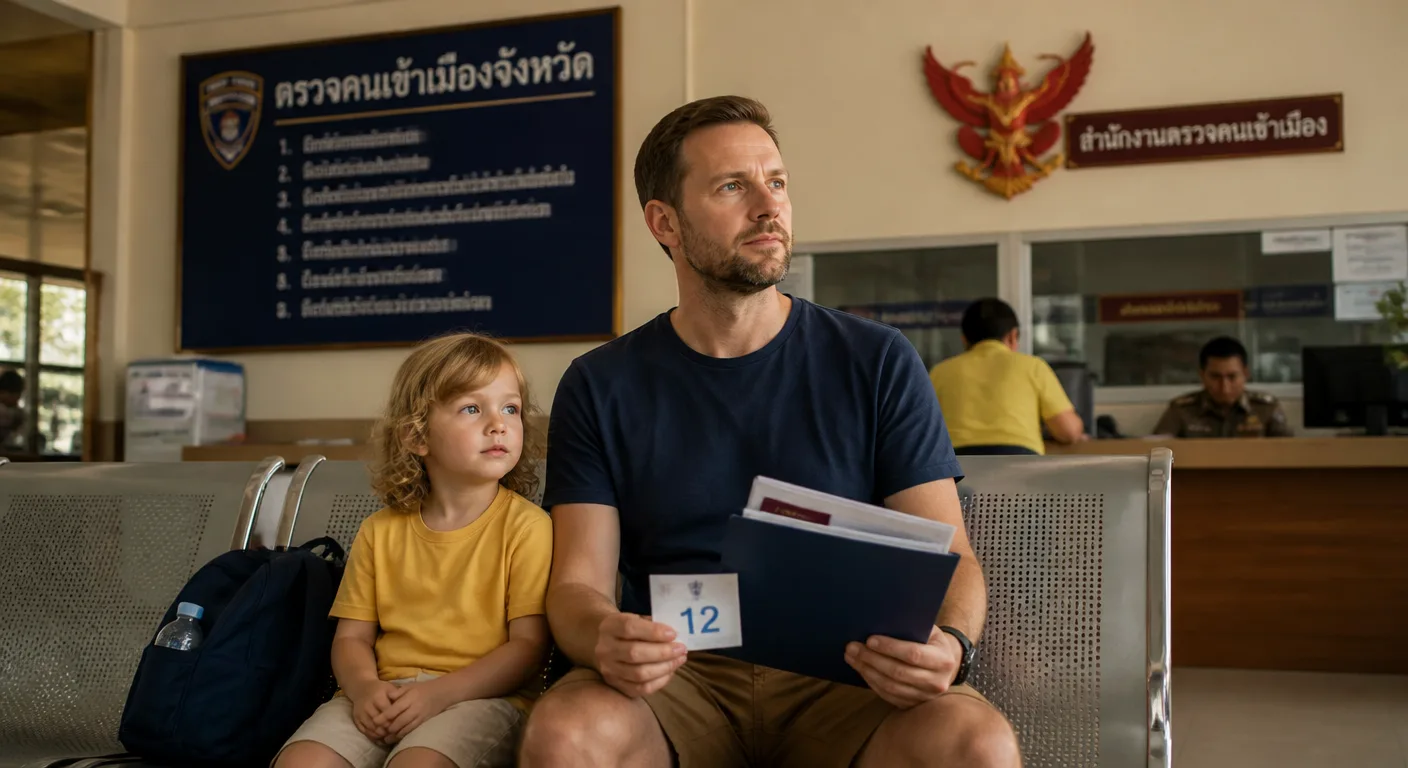
DTV Extensions and Border Runs: How Families Handle the 180-Day Cycle
When a family's 180-day DTV stamp is about to run out, they can either extend once in Thailand for 1,900 THB per person, or leave and re-enter for a fresh stamp — and several of the old border-run routes have closed since 2025.
 By Fabrizio Bestoso · · 16 min read
Our stamp date, three weeks out
We are looking at a school term that has six more weeks to run, four passports each carrying their own DTV entry stamp, and a date that does not care about any of that. The Destination Thailand Visa is valid for five years, but every entry into Thailand under it is stamped for up to 180 days, and that stamp — not the visa's five-year window — is what decides when a family has to act.
In our own household, only one of us runs this cycle: the mother and our daughter both hold Thai citizenship, so neither needs a Thai visa at all, and the foreign parent is the sole DTV holder in the family. We have also sat across the desk from several fully foreign couples and families, with no Thai citizen among them, helping them through the same paperwork. This guide is written for that fully foreign family — parents and children all holding their own DTV — using our own mixed household as a comparison, not as the reader's default case.
Before the detail, the shape of the decision:
- One extension is available per entry, filed in Thailand, for 1,900 THB per person.
- After that extension is used, there is no second one on the same entry — you must leave Thailand and re-enter.
- Every family member's stamp is separate: a spouse and each child need their own extension or their own re-entry.
- Some land exits families used for years closed in 2025 and 2026; check the current route before you book anything.
- Overstaying costs 500 THB per day per person, capped at 20,000 THB.
How the DTV's 180-day cycle actually works
A Destination Thailand Visa gives up to 180 days of stay per entry, and that stay can be extended once, in Thailand, for up to 180 more days, for a fee of 1,900 THB (about $55) per person — which is the core fact behind any DTV visa extension in Thailand. The visa itself keeps working for five years and multiple entries; it is the entry stamp, renewed every time you cross the border, that resets the clock.
That distinction matters because the DTV and the stay it grants are two different things. The visa, which we describe in full in our own application, is what lets you enter Thailand at all, potentially for years. The stamp in your passport on any given entry is what tells an immigration officer, and you, the date by which you must extend or leave. A spouse and children under 20 can hold DTVs as dependents of the main applicant, following the Royal Thai Consulate-General's DTV page, using the principal's supporting documents rather than their own proof of income. Each dependent still receives their own entry stamp, though, and once one family member travels alone and re-enters while the others stay put, the dates drift apart — which is exactly why we treat each passport as its own case rather than assuming the family moves as a unit.
Extend or leave? How we decide as a family
Most families meet this decision in the same order: is a trip abroad already on the calendar for some other reason, does the school term allow it, and does the math favor paying to stay or paying to travel. For us the first question usually answers itself — with work taking us to Hong Kong and Singapore fairly often, a trip out of Thailand is rarely something we have to invent. Because only the foreign parent in our household carries a DTV, the decision for us is a single passport, not four; a fully foreign family has to run the same calculation once for every member.
The school calendar comes next. An in-country extension changes nothing about term time; a border run means at least one travel day, sometimes two, built around flights or a land crossing that may not run to a convenient schedule. Then the arithmetic: for a family of four the extension fee alone is 7,600 THB, paid per person, and it buys a single extension per entry — measured against whatever a flight, a land crossing, or an organized border-run service would cost for four tickets.
| Option | What you get | Cost for a family of four (THB) | The catch |
|---|---|---|---|
| In-country extension | Up to 180 more days on the same entry, no travel required | 7,600 THB (~$225) | Only one extension per entry; approval is discretionary; each person applies and pays separately |
| Land exit to Laos from northern Thailand | A fresh 180-day stamp for each person on re-entry | Reported 2,400–6,400 THB (~$70–$190), DIY | A long travel day with children; crossing status can change without notice; figures are reported ranges, not fixed prices |
| Short flight to Kuala Lumpur or Singapore | A fresh 180-day stamp, the most predictable exit | Reported 12,000–32,000 THB (~$350–$940) | Airfares swing with season and how far ahead you book; still a full day of travel with kids |
| Organized border-run service | A minivan handles the crossing and paperwork for you | Reported 20,000 THB (~$590) | A convenience premium on top of the land-crossing cost; still depends on the crossing being open that day |
The last risk worth naming plainly: the extension is discretionary. A refusal close to the 180-day mark leaves little runway to book a flight and exit before every day past the stamp becomes an overstay, for every person on that stamp.
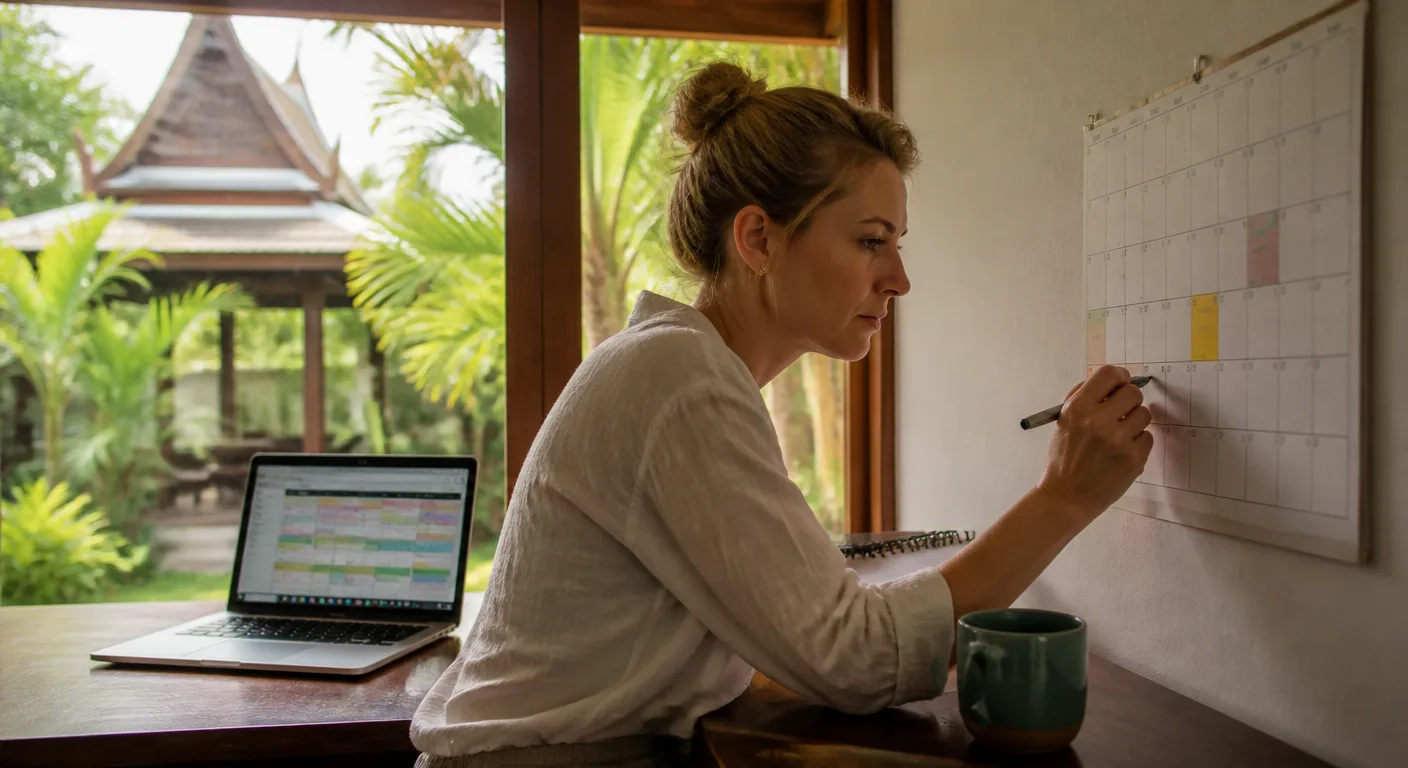
Pro-tip: write every family member's stamp date into one shared calendar the day you land. The dates stop matching the moment one parent travels alone and comes back on a different day than everyone else.
How to file the 180-day extension
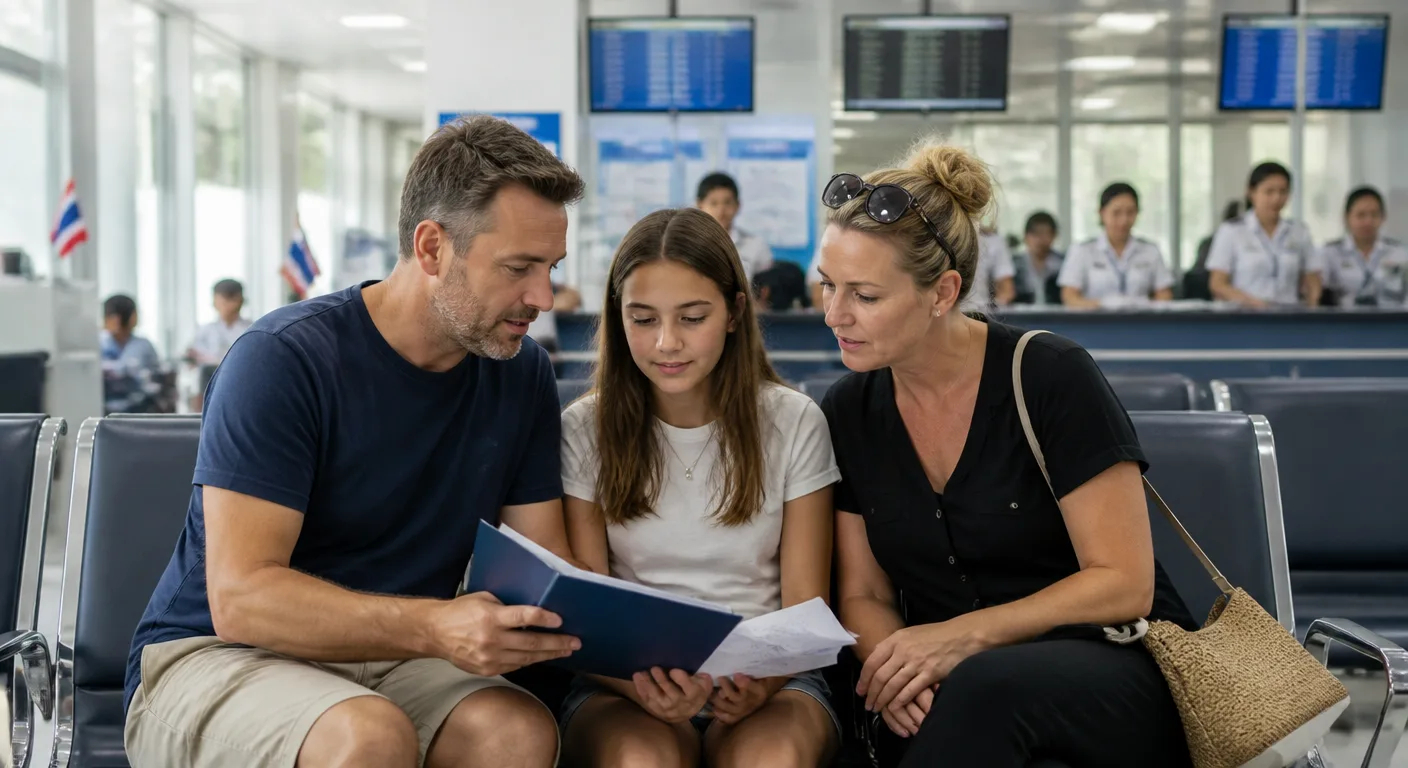
Extending a DTV in Thailand means filing form TM.7 at the immigration office covering your registered address, in person, with your documents and the fee, before your current stamp expires. The office reviews the application and, if it approves it, stamps a new date onto the same entry — up to 180 more days beyond the original 180.
In practice the steps run in this order:
- Check every family member's stamp date and confirm which ones need action in this cycle.
- Confirm the TM30 residence notification exists for your current address; offices ask for the receipt.
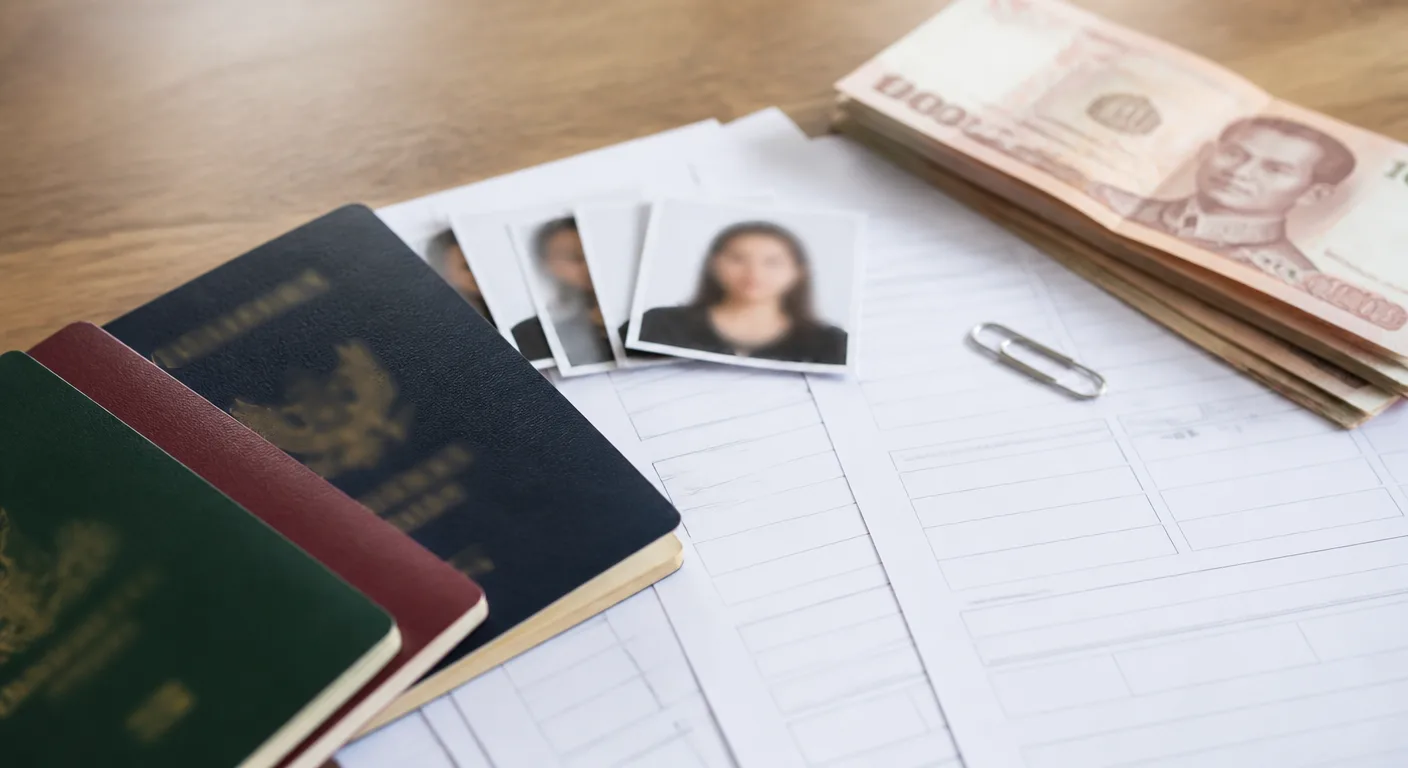
- Gather the documents per person: the TM.7 form, a 4×6 cm photo, your passport with copies of the photo page, visa page and latest entry stamp, the TM30 receipt, and a bank statement showing at least 500,000 THB.
- Go to the office early in the day; queues build up by mid-morning at busier locations.
- Pay the fee in cash — 1,900 THB per person.
- Check the new stamp in your passport before you leave the counter.
At our own extensions, in the offices we've used in Hua Hin, Cha-am and Nong Khai, nothing was asked for beyond the standard list — except our marriage certificate, which the officer wanted alongside the usual documents. The fee each time was 1,900 THB. That is our experience at those three offices, not a guarantee of what any other office will ask for.
Several things vary by office rather than by rule: how long the 500,000 THB needs to have sat in the account before you apply — one Chiang Mai source recommends applying around days 165 to 175 of the 180 — and how long processing takes, which is reported anywhere from same-day to about a week. Treat all of that as local practice to confirm with the specific office, not as a fixed national rule. The TM30 itself follows from what a long-term lease in Thailand really commits you to: the house owner or possessor, not the tenant, is the one obliged to notify immigration of a foreign resident.
Warning: apply before the stamp expires, not on the day it expires. Approval is discretionary, a refusal leaves little time to book an exit, and every day past your stamp date is an overstay for each person on it.
Border runs in 2026: which exits still work
A border run is a short trip out of Thailand and back purely to get a new entry stamp; a visa run is the broader term covering the same trip when the goal is any fresh stay, exemption or visa. For a DTV holder the trip is simpler than it sounds — the visa is multiple-entry, so leaving and coming back on it produces a new stamp of up to 180 days without any separate re-entry permit.
The routes have changed since many older guides were written. Every Thailand–Cambodia land crossing, including Poipet, has been closed since late June 2025 with no reopening date reported as of September 2026. Mae Sai–Tachileik into Myanmar is reported closed to foreigners. From the north, a border run from Chiang Mai typically means driving four to seven hours to Chiang Khong–Huay Xai or Chiang Saen on the Laos border. Our own usual exit is different: most often we cross overland from Nong Khai, where the mother's family has a house, over the Mekong to Vientiane. We last made that crossing in March 2025, and at re-entry the foreign parent in our family has never been asked for proof of funds or an onward ticket. Ranong–Kawthaung in the south into Myanmar is reported open, with travelers reporting the Thai side asking for cash on hand, a hotel booking and an onward ticket. For a family with children and a school calendar to protect, a border run from Bangkok most often means a short flight to Kuala Lumpur or Singapore rather than a land crossing at all — slower to arrange around fares, but far more predictable than a crossing whose hours or requirements can change without notice.
| Exit | From | Status as of September 2026 | Notes for families |
|---|---|---|---|
| Poipet / Aranyaprathet (Cambodia) | Bangkok / eastern Thailand | Closed since late June 2025, no reopening date reported | Do not plan around this route until it reopens |
| Mae Sai–Tachileik (Myanmar) | Chiang Rai | Reported closed to foreigners | Confirm with a local operator before traveling |
| Chiang Khong–Huay Xai (Laos) | Chiang Mai, about 4–7 hours by road | Reported open | A long day with children; check crossing hours before you set out |
| Nong Khai–Vientiane (Laos) | Nong Khai / Udon Thani area | Used by our family, last crossed March 2025; no current status confirmed, check before you travel | A straightforward bridge crossing in our experience; verify current requirements first |
| Ranong–Kawthaung (Myanmar) | Ranong, southern Thailand | Reported open, with cash, a booking and an onward ticket reportedly requested | Confirm requirements with a border-run agent before travel |
| Flight to Kuala Lumpur or Singapore | Bangkok, Chiang Mai or other airports | Standard immigration process, no land-border volatility | Most predictable option for a family with a school term to protect |
Two 2026 changes are easy to conflate with this and should be kept separate. The rule that takes effect on 15 September 2026, described in the Tourism Authority of Thailand's announcement of the new visa exemption rules, cuts the visa-exempt stay for most eligible nationalities from 60 to 30 days and generally limits entries under that exemption to twice a calendar year. That announcement covers visa-exemption entries; it says nothing about the DTV, and a family re-entering on a valid DTV is not using the exemption at all. Even so, other DTV holders report closer questioning at the border in 2026, sometimes including a request to show proof of funds, so it is worth carrying your bank evidence and address proof on any border run regardless of which rule technically applies to you. Separately, since 31 August 2026 a trip abroad no longer doubles as a chance to file a brand-new DTV application at a convenient neighboring embassy: new applications now go through the mission covering the applicant's own nationality or permanent residence.
Crossing status changes quickly and without much notice; check the current status of whichever route you plan to use the week you actually travel, not weeks in advance.
Pro-tip: the moment your passport is handed back at the counter, check the date on the new stamp before you walk away. We caught an officer's wrong entry date once, still standing a few meters from the counter, and had it corrected on the spot — a mistake that takes a minute to fix there and becomes an overstay problem if it's found later.
The paperwork that follows the whole cycle
Whichever route a family takes — extension or exit — three obligations keep running underneath it: the 90-day report, the TM30 address notification, and the overstay rules if a deadline is missed. None of them pauses just because you extended your stay or crossed a border for a new stamp.
Anyone in Thailand for more than 90 continuous days must file a TM.47 report, in person the first time and, after that, often online through the Immigration Bureau's portal; we cover exactly how the 90-day report works for every member of the family — including how the clock resets after a border run — in a companion guide. A new TM30 is generally expected after you re-enter or change address, since it is the address proof requested at any later extension. A re-entry permit is not needed to come back into Thailand on the DTV itself, because it is multiple-entry by design and each re-entry produces a fresh stamp; the permit only matters if you left in the middle of an already-extended stay and wanted to preserve that stay's original end date, since leaving without one ends the extension.
Overstaying carries a defined cost: an overstay in Thailand runs 500 THB per day per person, capped at 20,000 THB, and an overstay of more than 90 days is treated as a serious offense leading to deportation and a ban whose length depends on how long the overstay ran, according to the Royal Thai Embassy's overstay guidance. That fine applies per person, so a family that lets four stamps lapse together is multiplying the daily cost by four. Beyond the 180-day cycle itself sits the DTV's five-year expiry, at which point the family reapplies through Thailand's official e-Visa portal, now through the mission covering each applicant's own nationality or residence rather than any convenient embassy along the way.
None of this is legal advice; it is how our own family manages its stamps. A reader facing a refused extension, an overstay already underway, or a dependent on a different visa type should take that specific situation to their immigration office or a licensed Thai immigration lawyer rather than to this guide.
Frequently asked questions
Can you extend a DTV visa in Thailand?
Yes, once per entry. At the immigration office covering your address you can apply to extend a 180-day DTV stamp by up to 180 more days, for 1,900 THB per person. Approval is discretionary, so apply before the stamp expires. A second extension on the same entry is not available; you have to leave and re-enter.
How many days can I stay in Thailand on a DTV?
Up to 180 days per entry, and roughly 360 days in total if that entry's extension is granted. The visa itself is valid for five years with multiple entries, so each time you leave and come back on it you receive a new stamp of up to 180 days.
Does each child need their own DTV extension?
Yes. Every family member has their own passport stamp and their own permission to stay, so each needs an extension or a re-entry of their own, and each fee is paid per person. Check your office's document list for dependents before you go, because offices differ on what they ask children and spouses to bring.
Do I need a re-entry permit on a DTV?
Not to come back on the DTV itself. It is a multiple-entry visa, and re-entering on it gives a new stamp of up to 180 days. Leaving during an extended stay without a re-entry permit does end that extension, which only matters if you wanted to return to the same end date.
Does the two-entries-a-year border rule apply to DTV holders?
The limit announced for 15 September 2026 is written for travelers entering under the 30-day visa exemption, not for people entering on a valid visa such as the DTV. DTV holders still report closer questioning at re-entry, so carry proof of funds and your address in Thailand.
What happens if I overstay my DTV stamp?
Thailand fines overstays 500 THB per day per person, up to a maximum of 20,000 THB. An overstay of more than 90 days is treated as a serious offense and leads to deportation and a ban on returning, with the length of the ban depending on how long you overstayed.
Can I apply for a new DTV during a border run?
Not in the old way. Since 31 August 2026, new DTV applications go through the Thai embassy or consulate covering your country of nationality or permanent residence and need a police clearance certificate. A trip to a neighboring country resets your stay; it no longer doubles as a re-application.
Our 180-day planning checklist
Whichever way a family leans, the same list keeps a 180-day cycle from becoming a scramble:
- Record every family member's stamp date, in one shared calendar, the day you land.
- Decide extend or exit around six weeks out, not six days.
- Check the school calendar before booking anything.
- Confirm the TM30 is current for your address.
- Keep the bank balance and statements ready in case an extension is on the table.
- Check border-crossing status the week you actually travel.
- File the next 90-day report for every family member on time.
- Keep the DTV's five-year expiry and the new application rules in view, even while you're focused on the 180-day date.
Because we travel a lot, including for work to Hong Kong and Singapore, we are almost never in Thailand for 180 continuous days ourselves — each return on the DTV simply starts a new stamp, so for us the 180-day deadline matters less than the habit of checking each new stamp at the counter before we walk away. A family that stays in one place for the whole stretch meets the decision in this guide on a stricter schedule: about twice a year, whether they like it or not.
Visa rules, office practice and border status all change, sometimes with little notice. Your own immigration office and the official government announcements always override anything written here.
Sources
Written by Fabrizio Bestoso
Fabrizio Bestoso is a digital entrepreneur and the father of a family that lives and works on the move across Thailand, Asia, Spain and Middle East. He started Nomad Family Hub to turn the logistics his own family works through — the DTV visa, health insurance, multi-currency money, distance schooling, work — into step-by-step guides, each checked against official sources and against what actually happened.