Renting a Long-Term Condo or House in Thailand as a Family
A field-checked guide to signing a long-term condo or house lease in Thailand as a family, covering the 2025 rule change, deposits, utilities, TM30 and the clauses that matter most when children and a school year are involved.
 By Fabrizio Bestoso · · 26 min read

We signed our first Thai lease at a plastic table with two kids' school bags still packed by the door, a landlord waiting for three months' rent in cash by Friday, and a two-page contract in Thai that neither of us could read. My wife read it out loud, clause by clause, while our son asked when he'd get his own room. That is the actual starting position for most families doing this, and it is the position this guide is written from — not from research, but from four consecutive years of renting condo Thailand long term and short-term leases in our own name, before we eventually bought a house in Hua Hin.
The single most useful fact we can hand you up front is a date: 4 September 2025. That is when the rules governing Thai residential leases changed, and most English-language guides on renting a house in Thailand still describe the framework that was repealed that day. If you have already read about a one-month deposit cap or a five-day refund window, you are carrying numbers that no longer apply.
Before the sections below, here is what you actually have to decide, in order: what property type and city fit your family and budget; whether your landlord counts as a business landlord or a private one, because that decides which rules protect you; how much cash lands on the table on signing day; who bills your utilities and at what rate; and whose job it is to file the TM30 once you move in. Everything after this paragraph works through those five decisions in the order a family actually meets them.
Condo, townhouse or house: what long-term renting looks like for a family
A long-term residential lease in Thailand, in practice, is a fixed term of six or twelve months, renewable, with three years as the point where the paperwork changes and thirty years as the legal ceiling nobody renting for a school year needs to think about. Twelve months is the market default for families, because it lines up with a school year and gives a landlord enough certainty to negotiate on price.
The property type decision is the one families actually feel every day. A condo gives you a lift, a shared pool, on-site security and usually a rule about children and the pool hours; the kitchen is small and the neighbors are close. A townhouse buys space and a private entrance at the cost of stairs, storage that fills up fast with school materials, and neighbors who share a wall. A detached house gives a garden, room to work without headphones, and a much bigger electricity bill in hot season, plus mosquitoes and maintenance that a condo's building fund would otherwise absorb.
City choice interacts with all of this, and it is worth reading how Chiang Mai and Phuket compare for families before fixing on one. Chiang Mai rewards families who want space for the money; Phuket and Bangkok charge a premium for location and, in Phuket's case, for proximity to the beach and international schools.
| Property type | Typical family rent (THB/month, 2026) | Best for | The trade-off |
|---|---|---|---|
| One-bed condo, Chiang Mai | 8,000–15,000 (estimate) | A couple working remotely without kids yet, or a stopgap month | Too small once a second child or a home-school desk arrives |
| Apartment or small house, Chiang Mai | 15,000–30,000 (estimate) | Families wanting a garden and a school-zone address without Bangkok prices | Fewer English-speaking landlords; more Thai-only negotiation |
| Two- to three-bed condo, Bangkok | 25,000–60,000+ (estimate) | International-school families who need the BTS/MRT commute | Rent climbs fast with proximity to the good schools |
| Long-term coastal condo, Phuket | Priciest of the three markets (estimate) | Beach-proximity families with school-run flexibility | Holiday-market pricing bleeds into long-term listings |
| Three-bed villa with private pool, secured village, Hua Hin | 15,000–20,000 (our own market observation, 2026) | Families who want space, a pool and security without Phuket money | Fewer international schools nearby than Bangkok or Phuket |
That Hua Hin row is the one figure in this table we did not read anywhere — we live in this market. The trap for a searching family is that portals quote Hua Hin at nightly or short-stay holiday rates, which are multiples of what the same villa lets for on a genuine twelve-month term. A three-bedroom pool villa that looks like a resort price online is a different product once you sign for a year, because the landlord is pricing certainty rather than a holiday week.
Twelve months is the standard residential lease term in Thailand, and a lease longer than three years must be registered at the Land Office to be enforceable for its full term — which is one reason almost nobody signs for longer.
The rules that changed in 2025 — and who they actually protect
The instrument that governs Thai residential leases today is the Notification of the Contract Committee Re: The Stipulation of Residential Property Leasing as a Contract-Controlled Business, B.E. 2568 (2025), published in the Government Gazette on 6 June 2025 and in force from 4 September 2025. It replaces the 2019 notification that most older guides still quote, and it reduced the scope from five units to three or more — including leases arranged through online platforms. You can read the government's own briefing on the residential lease rules directly, though it is only published in Thai.
The distinction that decides everything for a reader of this article is simple to state and easy to miss: a business landlord lets three or more residential units, and every protection below belongs to that group. A private landlord — the retired Thai couple renting out the house next to their own, or the single condo an owner bought as an investment — sits outside this regime entirely. Their tenants are governed only by the contract they sign and the Civil and Commercial Code. Nobody we read had confirmed whether that three-unit count is per building, per landlord, or across separately owned properties, so treat the edge cases with a Thai lawyer rather than a guess.
| What the 2025 rules say | Business landlord (3+ units) | Private landlord (1–2 units) |
|---|---|---|
| Deposit + advance rent cap | Combined maximum 3 months' rent | Whatever the contract states |
| Deposit return window | Immediately, or within 7 days if inspected with no damage, 14 days if repairs deducted | Whatever the contract states |
| Move-in condition report | Required, jointly signed, attached to the lease | Good practice, not required |
| Utility charging | Capped at the utility's own rate; no margin; method must be written into the contract | Whatever the contract states |
| Mid-lease rent increases | Prohibited before the term ends | Whatever the contract states |
| Tenant early termination | Allowed after 50% of the term, on 30 days' notice, debts settled | Whatever the contract states |
| Landlord notice to terminate | 30 days' written notice (7 days for urgent misconduct affecting other tenants) | Whatever the contract states — ours said 30 until we changed it |
| Renewal fee | Prohibited clause; treated as if never written | Whatever the contract states |
| Penalty for breach | Up to 1 year imprisonment, fine up to THB 200,000 (~USD 6,100 at 32.9), or both | Not applicable |
The landlord-notice row is the one that matters most to a family and the one every ranking page skips. A business landlord may end a lease on 30 days' written notice, and a private landlord's notice period is whatever the two of you wrote down — which is exactly the clause we caught in our own contract and describe in the next section.
Warning: if a guide you are reading quotes a one-month deposit cap, a five-day refund window, or a THB 100,000 fine, it is describing the 2019 rules that were repealed on 4 September 2025. Check the date on anything you are planning your move around, including this one.
Since 4 September 2025, a landlord letting three or more residential units in Thailand may not collect more than three months' rent in combined advance rent and deposit, and must return the deposit within seven days of the lease ending where there is no damage.
What the lease actually says
Once you get past the headline numbers, a Thai residential lease is mostly the same clauses any lease has, in a different order and, usually, a different governing language. The term and renewal clause sets your twelve months and what happens if you stay past it. The deposit clause sets the amount and what can legally be deducted from it — under the 2025 rules, ordinary wear and tear cannot be charged against a business landlord's tenant, though a private landlord's contract might still try. Repairs are the landlord's responsibility except for damage the tenant caused; get that split written down rather than assumed. Notice periods run both ways, and the move-in condition report — now part of the contract rather than a courtesy — is what settles any dispute about what was already broken.
Registration and duty sit quietly underneath all of this. A lease longer than three years has to be registered at the Land Office to be enforceable for its full term, at roughly 1% of the total rent for the term, and separately, the Revenue Department's stamp duty schedule sets stamp duty on any lease at THB 1 for every THB 1,000 (0.1%) of the total rent for the whole period, payable by whoever provides the rent. For a twelve-month family lease neither of these usually comes up, which is exactly why twelve months and three years are the practical standard.
Yes, a Thai rental contract is binding on a foreigner, in the same way any contract is binding on the person who signs it — foreigners face no restriction on renting residential property in Thailand at all; the restrictions in Thai law are on owning land, not on renting it.
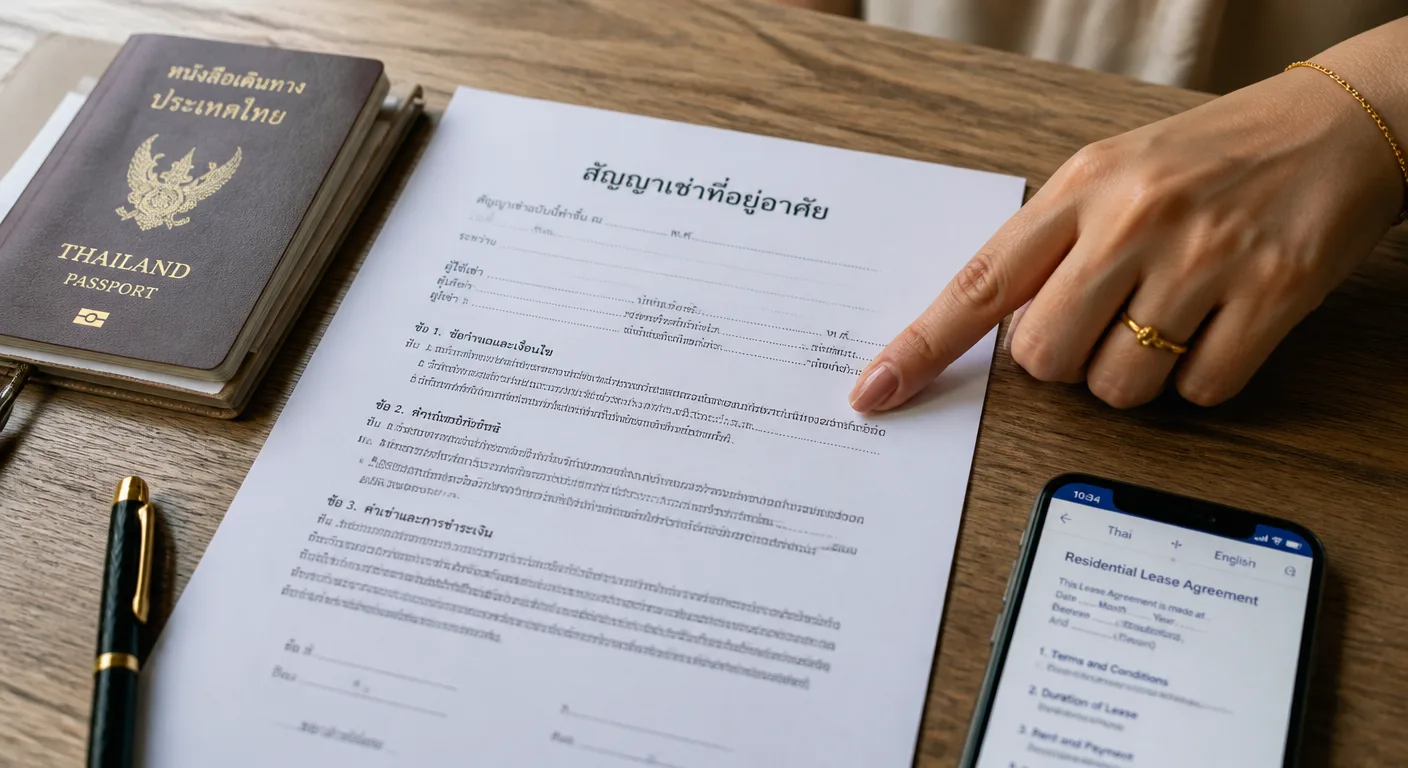
Warning: where a lease exists in both Thai and English, find out — before you sign, not after a dispute — which version actually governs. It is usually the Thai one, and the two documents are not always identical. This is exactly where having someone read the Thai text pays for itself. In one of our own twelve-month leases, the Thai draft gave the landlord a discretionary right to end the lease on 30 days' notice, buried in a clause that read, in English, like an ordinary termination provision. My wife caught it reading the Thai text aloud at the table. We asked for it to be extended to 90 days, the landlord agreed, and that was the version we signed. A thirty-day discretionary exit inside a fixed twelve-month term quietly turns the year you thought you had bought into thirty days — and for a family, that can mean finding a new house and packing mid-school-term. Ninety days is roughly a school term's warning, and it is negotiable upward far more often than tenants think to ask.
Deposit, advance rent and the cash you need on signing day
Budget for cash, not a card. Move-in day in Thailand still runs on a bank transfer or cash handed over at the table, and the total is usually more than the rent figure alone suggests once agent fees, utility deposits and furnishing gaps are added in.
| Item | Typical amount (THB) | Approx. USD | Notes |
|---|---|---|---|
| Advance rent | 1 month's rent | ÷32.9 | Paid on signing, before move-in |
| Security deposit | 2 months' rent | ÷32.9 | Market convention; capped at 3 months total (deposit + advance) for a business landlord |
| Agent fee | Usually THB 0 to the tenant | — | Conventionally paid by the landlord; confirm before assuming |
| Electricity/water account transfer | 500–3,000 (estimate) | ~15–91 | Deposit to open the meter account in your name, refundable |
| Furnishing top-up | Variable | Variable | Fans, extra bedding, a proper desk for schoolwork — "fully furnished" is a starting list, not a promise |
| Total for signing day | ~3 months' rent plus small transfers | at 32.9 THB : 1 USD (checked 2026-09-07; re-check on the day) |
That exchange rate — roughly THB 32.9 to USD 1 — is the basis for every USD figure in this article; rates move day to day, so treat the dollar numbers as approximate and check the day's rate yourself before you wire anything.
The three-months-of-rent figure is doing two different jobs at once, and it matters which one applies to your landlord. For a business landlord, three months combined is a legal ceiling they cannot exceed. For a private landlord with one or two units, it is simply the market convention everyone quotes — which means it is negotiable, particularly on a twelve-month term with a family that is visibly staying rather than passing through. Before you accept the first number an agent gives you, it is worth comparing it against what a nomad family actually spends each month across Thailand, so the housing line sits inside a realistic monthly budget rather than in isolation.
Budget three months' rent in cash for signing day — one month in advance plus two months' deposit is still the common ask, even though a business landlord may not exceed three months in total.
Utilities, and the markup nobody quotes you
This is the single most common overcharge we have seen in the Thai rental market, and it takes one of three forms. The cleanest is the utility's own bill, in your name, on your own meter — you pay exactly what the provider charges. The second is a pass-through, where the landlord's account stays in their name and they forward you the actual bill. The third, and the one to watch for, is a flat re-bill at a per-unit rate the landlord simply invented, usually well above cost.
The 2025 rules put a stop to the third practice for business landlords: water and electricity may not be charged above the rate the utility charges the landlord, no margin may be added, and the calculation method has to be written into the contract. A separate change in 2026 matters just as much. Following a National Energy Policy Council resolution on 15 July 2026, rented houses, dormitories and apartments — including homes with no house registration — were moved into the residential electricity category rather than the higher commercial or temporary rate, and the ERC's decision of 12 August 2026 implemented that shift. The first 200 units for residential users were also capped at THB 3 per unit. For the September–December 2026 billing period, the ERC held the nationwide average tariff at THB 3.95 per unit excluding VAT, coming out to roughly THB 3.89 per unit after relief measures — a figure tied to that specific period and due to be reset before January.
We can give you a real benchmark rather than a forecast, because it is our own house, on our own meters, billed directly by the utility with no landlord standing in between. Our detached house in a Hua Hin village runs THB 800–2,000 a month for electricity, air conditioning included — the pool is on a separate meter and is not in that figure, because a pool is a real and separate cost. Water runs under THB 100 a month. We are aware that sounds too low; it is what the meter says.
Set against that, the range most guides repeat for an apartment's combined electricity, water and gas is THB 2,500–4,500 a month — above what our air-conditioned house costs on its own meters. Some of what circulates as "the cost of utilities in Thailand" is landlord re-billing rather than actual consumption, and our figures are one data point that supports that, not proof of it for every household. Ours is one house, in one town, on our own air-conditioning habits, and we own rather than rent it — usage is the biggest variable in any bill, so treat this as a benchmark to measure a landlord's number against, never as what you will pay.
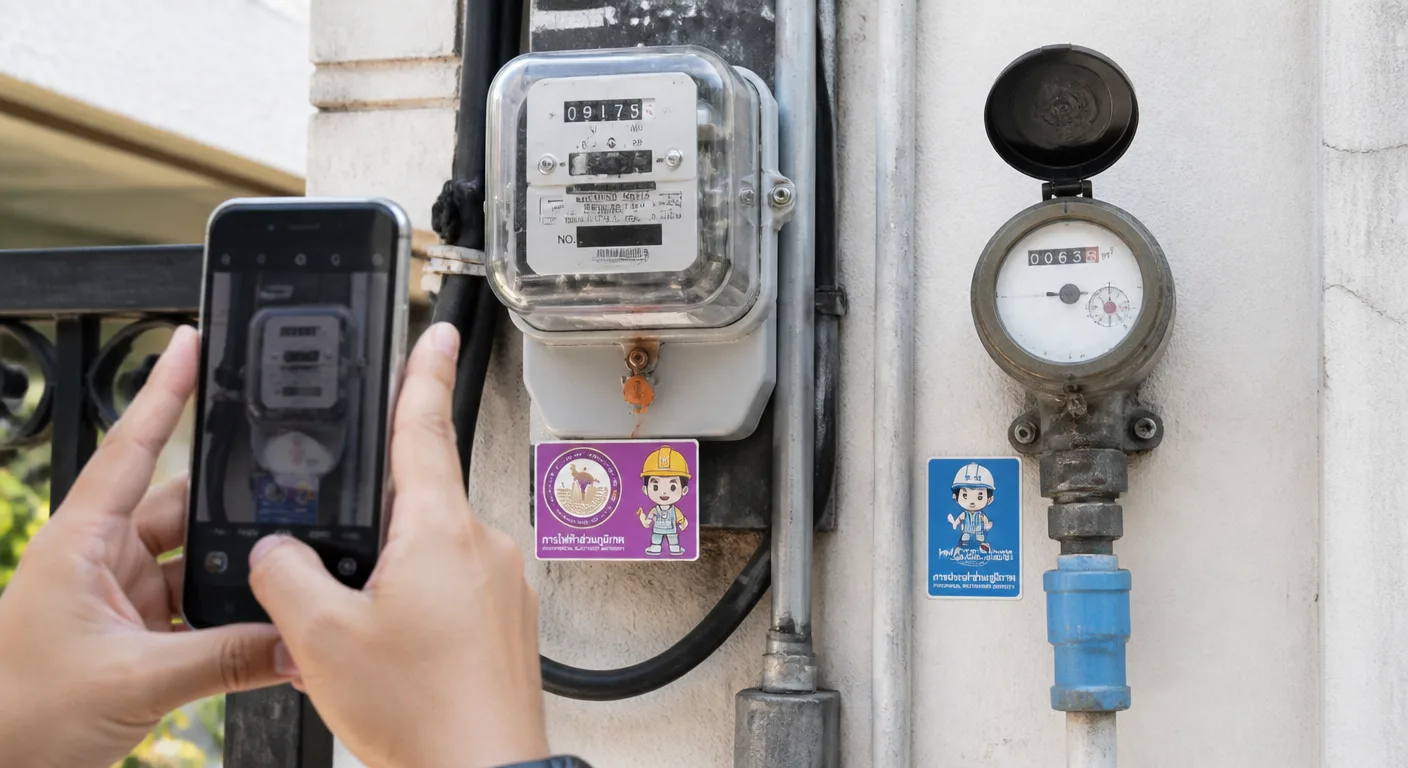
The practical check costs nothing: photograph both meters at move-in, insist on the written invoice — landlords must now deliver it at least three days before the due date — and compare the per-unit rate on it against the utility's published tariff. If you want to see what these figures look like across a full month's household budget, our month-by-month Chiang Mai budget walks through the running costs line by line.
Pro-tip: ask, before signing, whether utilities will be billed at the provider's rate or the landlord's rate, and get the calculation method written into the contract — for a business landlord that is now a legal requirement, not a favor.
How we actually find places — and negotiate them in Thai
The best family houses in Thailand rarely reach an English-language portal. They circulate in Thai-language Facebook groups, through LINE contacts, and by word of mouth in the village or soi — which is one more reason a Thai speaker at your side is worth more than any listing filter. What you find on FazWaz or Hipflat is real inventory, but it is the inventory landlords could not fill through their own network first, and the pricing reflects that.
Agents in this market are conventionally paid by the landlord rather than the tenant, so treat the listed price as an opening position, not a fixed number — the agent has an interest in closing the deal, not necessarily in getting you the lowest rent. That changes what you can reasonably ask for once you understand it.
What we have found landlords willing to move on: the term length, a free week or month at the start of a longer lease, repairs completed before move-in, and sometimes the deposit itself if you can show a stable income and a long intended stay. What they rarely move on: the headline rent itself, especially in a popular school-zone soi, and the requirement for cash or a bank guarantee up front. Rent house in Chiang Mai searches in particular turn up a wide spread of asking prices in the same neighborhood, which is usually a sign of how much room there is to negotiate rather than a sign of genuinely different properties — a pattern that holds for long term rental Chiang Mai listings generally.
Pro-tip: view the property in the rainy season if you can, or at minimum ask to see it after a heavy downpour, and ask the neighbors — not the agent — about flooding history and how bad the burning-season air gets in that particular soi.

Renting with kids: the checks a solo nomad never makes
A single remote worker can forgive a lot in a rental that a family cannot, and the checks below are the ones we now do that we never thought of before we had children in tow.
- The school run, measured at the hour it happens. A route that looks like ten minutes on a map can be forty in real traffic at 7:40 a.m.; drive or walk it at the actual time before you sign.
- Air quality and sealing. During burning season, ask whether the house can be closed up and filtered, and whether the air conditioning units double as a real barrier against outside air.
- The soi itself. Motorbike traffic, street lighting after dark, and loose dogs on the walk to the gate matter more day to day than the finish on the kitchen counters.
- Pool access. If there is a pool, ask whether it is fenced separately from the garden and whether it is ever supervised — a shared village pool is not a childminder.
- Distance to a hospital you would actually use at 2 a.m., not the nearest clinic on a map.
- Water supply and drinking water, and whether it is safe to drink from the tap or needs a delivered supply.
- A room that can actually be a work call room, not the kitchen table with children doing schoolwork six feet away.
- Storage for a full school year of materials — worksheets, books and projects accumulate faster than most rentals plan for.
A twelve-month lease and a school year rarely start on the same date, and a term that ends mid-year is a problem you feel later, when you are hunting for a new house in the middle of a semester rather than over a break. This is also where the landlord's notice clause becomes a school-year question rather than a legal abstraction: whatever notice a landlord can give you is the real length of your housing security, not the twelve months printed at the top of the lease. Read that clause before you read the rent figure, and ask for ninety days — thirty does not survive contact with a school term.
The paperwork after you sign: TM30, and what a lease unlocks
Under section 38 of the Immigration Act B.E. 2522 (1979), the house master, owner or possessor of the property — not the tenant — is required to notify the Immigration Bureau that a foreign national is staying there, within 24 hours of arrival. A fresh notification is generally expected after re-entering the country or changing address, and the receipt is what an immigration officer asks for at 90-day reporting and at extensions.
The practical trouble is that the legal duty and the practical consequence land on different people. Your landlord is the one who is supposed to file it; you are the one standing at the counter without a receipt if they didn't. We have never filed one ourselves — that obligation has always sat with our landlords — so we will not pretend to describe the online process from the inside; what matters for you is asking for the filed receipt at move-in and again after every trip abroad, and not assuming an agent has handled it on your behalf.
A signed lease then works for you in two other ways that have nothing to do with immigration. It is the address document most international and local schools ask for at enrollment, and it is the paper trail behind your own 90-day reports and any residence certificate you might need later. Get a copy of the landlord's ID and their house book at signing — not three months later, when a school deadline is running and the landlord is unreachable.
Under section 38 of the Immigration Act, the owner or house master must notify immigration within 24 hours that a foreign national is staying at the property — which means the filing is your landlord's job and your problem.
Getting the deposit back, and the mistakes we made
The hand-back goes smoothly when the record was built at move-in, not assembled at move-out. We photograph every meter and every existing scratch or stain on day one, before a single box is unpacked, and we make sure the move-in condition report — now part of the contract for a business landlord rather than an optional courtesy — is signed by both sides on the spot. Under the 2025 rules, a tenant of a business landlord cannot be made liable for ordinary wear and tear; only actual damage, documented against that report, can be deducted.
For a business landlord, the deposit comes back immediately at the end of the lease, or within 7 days if an inspection turns up no damage, or within 14 days where repair costs are being deducted. Final utility bills usually arrive after move-out, so settle those before you expect the last cent of the deposit. If a deposit does not come back on schedule, the first step is a written demand referencing the lease and the notification's timelines; the second, for a landlord inside the regime, is a complaint to the Office of the Consumer Protection Board — by the hotline 1166, the OCPB Connect app, the OCPB website, or a provincial Damrongtham Center. That route exists only for landlords who fall inside the three-or-more-unit regime; a private landlord dispute is a civil matter between you and the contract you signed, which is exactly why the contract has to say something on this point.
We have not had a deposit withheld or come back short, so we are not going to manufacture a story we have never lived. What we can offer is the checklist we now run every time, and why each line exists:
- We photograph both meters on move-in day, because a dispute about usage six months from now is unwinnable without a starting number.
- We view or ask about the property after heavy rain, because flooding and damp are easier to hide on a dry viewing day than to fix after you have signed.
- We confirm who is actually filing the TM30, rather than assuming an agent has done it, because the consequence of it not being filed lands on us, not on the landlord.
- We treat "fully furnished" as a room-by-room list to walk through with the landlord, item by item, rather than a promise — because the gap between the two is exactly where move-in week gets expensive with two kids waiting for beds.
Frequently asked questions
Can foreigners rent a condo or house in Thailand long term?
Yes, without restriction. The limits in Thai law are on owning land, not on renting it. You need a passport, and for a twelve-month term most landlords prefer a long-stay visa over a tourist entry. There is no credit check; landlords judge on documents, the deposit offered, and the impression made at the viewing.
How much deposit is normal, and is it capped?
Two months' deposit plus one month's advance rent is still the common ask, so plan on three months' rent in cash. Since September 2025, a landlord letting three or more residential units may not take more than three months in advance rent and deposit combined. A private owner with one condo sits outside that cap entirely.
How fast must a landlord return the deposit?
For landlords inside the 2025 regime, immediately at the end of the lease — within seven days if an inspection is needed and nothing is damaged, or within fourteen days where documented repair costs are deducted. For a private landlord, the refund window is whatever the contract says, which is exactly why it needs to say something.
Can my landlord charge whatever they like for electricity?
Not if they let three or more units. Water and electricity must be charged at no more than the rate the utility charges the landlord, with no margin added and the calculation method written into the contract. Compare the per-unit rate on your invoice against the utility's published tariff every month.
Does the lease have to be in Thai?
Contracts in the regulated category must be in legible Thai, and a bilingual version is common. What matters is which language governs, because it is usually the Thai one. Have the Thai text read by someone who reads Thai before you sign — not the English translation an agent hands you.
Who files the TM30, and what happens if nobody does?
Your landlord. Thai law puts the notification duty on the owner or house master within 24 hours of a foreign national moving in. The consequence, though, lands on you: immigration asks for the receipt at 90-day reports and extensions. Ask for a copy at signing, then again after every trip abroad.
Can we break a twelve-month lease early?
Under the 2025 rules, a tenant of a business landlord can terminate a fixed-term lease after living there for at least half the term, giving 30 days' written notice and settling what is owed. With a private landlord, early exit is whatever the contract allows — usually forfeiting the deposit, and usually negotiable before you sign rather than after.
How much notice can the landlord give us to leave?
For a landlord letting three or more units, 30 days' written notice, or 7 days for urgent misconduct affecting other tenants. For a private landlord it is whatever the contract says — and Thai drafts often grant a discretionary exit on 30 days. Read that clause before you read the rent, and ask for 90 days: a month's notice does not survive a school term.
Can the landlord raise the rent mid-lease?
Not inside the regulated category: raising rent or service charges before the term ends is a prohibited clause, and prohibited clauses are treated as if they were never written. Outside it, the contract governs, so check for a review clause before signing a twelve-month term.
Is a lease enough for school enrollment and visa paperwork?
It is the address document most schools and immigration offices ask to see, alongside the TM30 receipt. Collect the landlord's ID copy and the house book copy at signing; requesting them months later, when a school deadline is running, is slower than it sounds.
What we check before signing
Before any signature goes on a Thai lease now, we run the same short sequence: confirm whether the landlord falls inside the 2025 business-landlord regime or is a private owner outside it; agree which language version of the contract governs; get the utility calculation method written down rather than promised; photograph every meter and every existing mark in the property; sign the move-in condition report jointly; confirm, by name, who is filing the TM30; and put the deposit-return timeline in writing even if the law already sets one, because a written figure is easier to point back to than a section number.
What surprised us most, across four years of doing this with children in the house, was not the paperwork — it was how much of a family's actual housing security turns out to live inside a single notice-period clause rather than in the rent figure everyone negotiates over. A cheap house with a thirty-day exit clause is not actually cheap once you count what a mid-term move costs a school-age child.
Rental practice, utility tariffs and immigration procedure in Thailand all continue to change, and your own landlord, your own utility office and your own immigration office will always have the final word over anything written here — this guide is a starting map, not a substitute for reading your own contract, in whichever language actually governs it.
Sources
Written by Fabrizio Bestoso
Fabrizio Bestoso is a digital entrepreneur and the father of a family that lives and works on the move across Thailand, Asia, Spain and Middle East. He started Nomad Family Hub to turn the logistics his own family works through — the DTV visa, health insurance, multi-currency money, distance schooling, work — into step-by-step guides, each checked against official sources and against what actually happened.