Opening a Thai Bank Account as a Foreign Family (What Actually Works in 2026)
In 2026, opening a Thai bank account as a foreigner depends on your visa, not your passport: most major banks now require a long-term non-immigrant or LTR visa. Here is what a mixed Thai–foreign family's branch visits actually looked like, and what to do when the bank says no.
 By Fabrizio Bestoso · · 15 min read

Opening a Thai bank account as a foreign family in 2026
We first needed Thai bank accounts when we bought our house in Hua Hin. Between us we now hold accounts at Kasikornbank (KBank) and Krungsri in Hua Hin, and at Siam Commercial Bank (SCB) in Nonthaburi. We are a mixed Thai–foreign family, and that mix matters more than most articles on this topic admit.
If you are reading this, you have probably already hit the wall: a landlord who wants the deposit by bank transfer, a school invoice due in baht, and a bank counter where the answer to "can I open an account on this visa" is no. Before we go section by section, here is the shape of it. Most major Thai banks now require a long-term non-immigrant or LTR visa to open a new personal account. The DTV is generally refused. Proof of address usually means an Immigration certificate of residence, not a lease. A Thai spouse, or a family on an LTR visa, has routes a DTV holder does not. And the 2026 changes to Wise's Thai accounts mean a real Thai bank account matters again for anything larger than everyday spending.
Can a foreigner open a Thai bank account in 2026?
Yes, but not on every visa. Since 2025, most major Thai banks, including Bangkok Bank, Kasikornbank and SCB, open new personal accounts for foreigners only on a long-term non-immigrant visa (Non-B with a work permit, Non-O, Non-ED) or an LTR visa. Tourist visas, visa exemption stamps, visa on arrival and the DTV are generally refused. That is the honest, if unsatisfying, answer to whether you can just walk into a branch and open Thai bank account foreigner-style, the way you might in many other countries.
The reason is not a Thai law banning foreigners from banking. We could not find any Thai statute for this guide that prohibits it. What changed is bank compliance policy, tightened through 2025 following the Bank of Thailand's January 2025 measures against mule accounts, which told banks to suspend transfers on high-risk accounts, refuse new accounts to high-risk individuals, and share suspicious-account lists across the industry. The notice itself never mentions foreigners or visa categories. Each bank chose, on its own, to translate "high risk" into a visa checklist, and each bank drew that line slightly differently. That is also why two branches of the same bank can give you two different answers on the same afternoon: head office sets the policy, but a branch manager still has to interpret it against the document in front of them.
Since 2025, most major Thai banks, including Bangkok Bank, Kasikornbank and SCB, open new personal accounts for foreigners only on a long-term non-immigrant or LTR visa, and generally refuse tourist, visa-exempt and DTV holders.
Which visa in the family should open the account
The first real decision is not which bank to use, but which family member's visa gives you the best shot at the counter. Each of us has our own personal Thai account, so this is not a theoretical exercise for us: the foreign parent opened accounts at KBank and Krungsri in Hua Hin on a Non-O visa based on marriage to a Thai citizen. All of our accounts were opened before 2025, before the current tightening. That matters: our experience sits in the Non-O row of the table below, from a period when policy was looser, and it should not be read as evidence that a DTV would work today.
For a family where nobody holds a Non-O, Non-ED or Non-B, or an LTR visa, the practical options are a Thai citizen spouse's own account, an LTR dependent visa if the family qualifies, or accepting that Thai banking will wait until someone's status changes. It is worth remembering that a Thai bank account is not a requirement of the DTV itself: the 500,000 THB proof for our DTV application can be held abroad, in a foreign-currency account, so a family can be fully compliant with the visa and still have no Thai bank account at all.
| Status | Can it open an account at most major banks? | What banks typically ask for | Notes for families |
|---|---|---|---|
| DTV (principal or dependent) | Generally no | N/A at most branches; reported exceptions exist at individual branches | Do not plan around an exception; treat it as unavailable |
| Tourist visa / visa exemption | No | N/A | Same policy reasoning as the DTV row |
| Non-O (married to a Thai citizen) | Yes, reported | Marriage certificate, certificate of residence, sometimes the Thai spouse's ID and house registration | Our own accounts fall in this row, opened before the 2025 tightening |
| Non-ED | Yes, reported | Enrollment or school letter, certificate of residence | Ask the school if it has a preferred bank for this |
| Non-B with work permit | Yes | Work permit, passport, certificate of residence | The most consistently accepted category |
| LTR and LTR dependents | Yes | LTR visa, marriage or birth certificate for dependents, proof of Thai address, purpose documents (e.g., a school letter) | See the Board of Investment's guidance for LTR visa holders, which names Bangkok Bank and Kasikornbank |
| Thai citizen spouse | Yes, no visa restriction | Thai ID card, house registration | Faces none of the visa-based rules covered here |
There is no single "best bank in Thailand for foreigners" in the sense of a ranking; the better question is which bank accepts the visa the qualifying family member actually holds, since policy and document lists differ enough between Bangkok Bank, KBank, SCB, Krungsri and UOB that the right bank for you is whichever one matches your status and, ideally, has a branch near where you already have your address registered.
What to bring to the branch
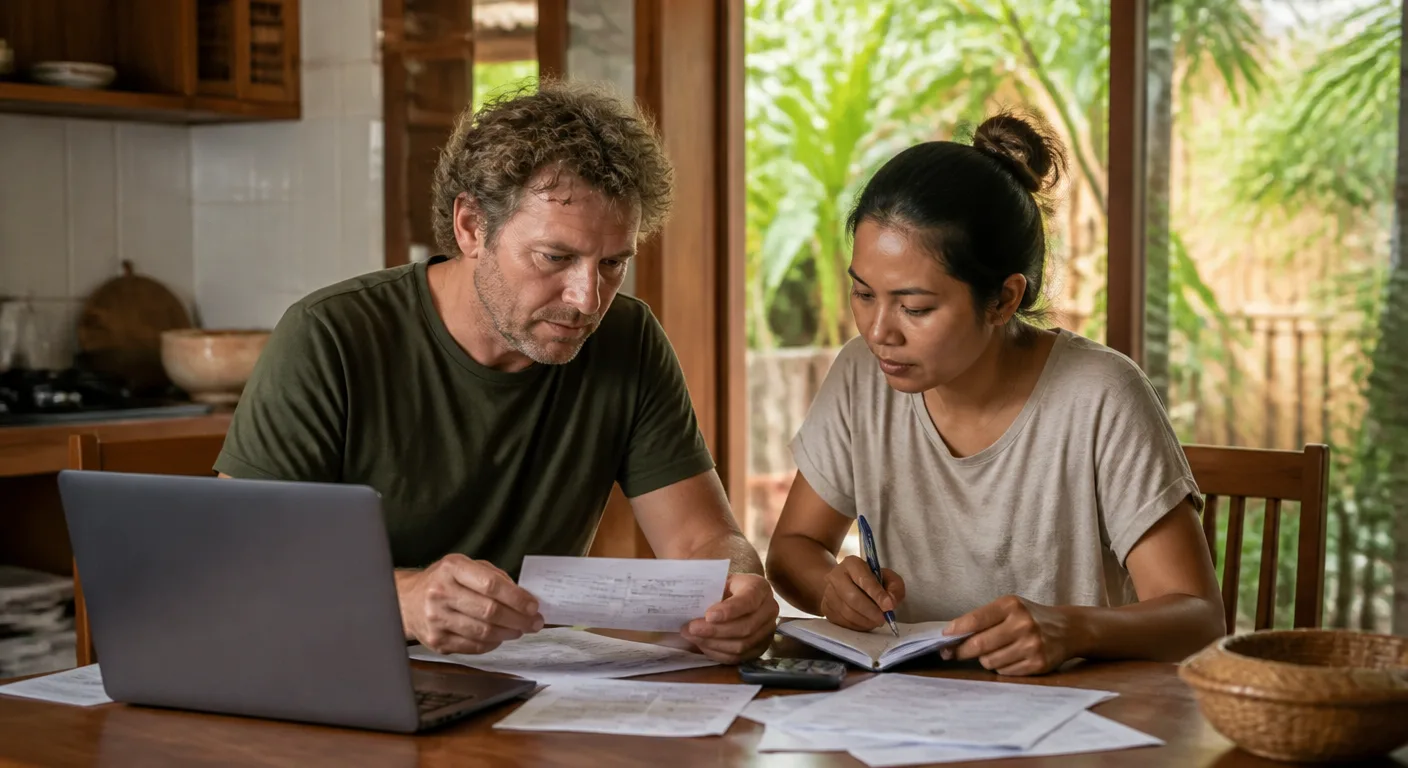
Whatever your qualifying visa, the branch visit runs on paperwork, and it goes faster if you assemble it before you go rather than mid-appointment. In our own case, the documents our branches actually asked for were the visa and the tabien baan, the house registration book, which for foreigners is the yellow one, rather than the longer lists forums sometimes describe.
A reasonable checklist, built from what several banks and branches report asking for, looks like this:
- Original passport, valid for at least six months.
- The qualifying visa or extension stamp in it.
- Proof of a Thai address: an Immigration certificate of residence is the document branches trust most, though a lease or the yellow tabien baan is accepted at some branches, inconsistently.
- A Thai mobile number, since the banking app and one-time codes are tied to it.
- A work permit, if you hold a Non-B visa.
- The opening deposit the branch asks for.
- For spouses and dependents: the marriage or birth certificate, translated and legalized if it was issued abroad.
At the counter itself, ask for a standard savings account rather than anything more complex, and have staff activate the mobile app before you leave the branch; getting it working later without someone in front of you who can read the Thai-language prompts is harder than it needs to be. Make sure your name is entered exactly as it appears in your passport, since a mismatched spelling causes problems later with transfers and with linking a debit card to online payments.
Warning: get your certificate of residence sorted before the bank visit, not the same day. Immigration issues it only once a TM30 is on file for your address, and processing has been reported to take anywhere from same-day to about two weeks depending on the office.

When the bank says no: the Thai-spouse route and the alternatives
For a mixed Thai–foreign family, the most reliable fallback when a foreign parent's visa does not qualify is the Thai spouse's own account, since a Thai citizen spouse faces none of the visa-based account restrictions that apply to foreigners. Some banks, including Bangkok Bank and SCB, are reported to offer a joint account between a foreigner and a Thai citizen, which keeps both names on the paperwork even if only one of you meets the visa requirement. The trade-off is straightforward: the money legally sits mostly in one person's name, which can matter if the Thai spouse travels, if the couple later separates, or if a landlord or school wants proof of whose funds paid a bill. That is why, even where a household leans on a spouse's account, the foreign parent generally still wants their own account the moment their status allows it.
We should be clear that this is not how our own household works: each of us holds our own personal Thai account, so we are describing an option here, not our arrangement.
For a family with no Thai citizen at all, the realistic paths are narrower. One is trying another bank or branch, without any promise attached, since policy is applied unevenly and a branch that refuses you may simply be more cautious than average, not necessarily following a different rule. A second is waiting until someone in the family holds a visa that qualifies, whether that is a Non-B through employment, a Non-ED through a child's school, or an LTR visa. A third is paying rent, deposits and bills from a foreign account or through Wise, which is workable for smaller, regular payments but gets harder for the larger, one-off amounts covered in the next section. Some DTV holders do report opening a savings account at an individual Bangkok Bank or KBank branch, usually with a Thai phone number, proof of address, and a larger opening deposit; others report the opposite, that Bangkok Bank now treats the DTV as tourist-level for this purpose. Neither should be read as a method that works reliably, only as evidence that outcomes vary by branch.
Once you know what our family actually spends in Thailand each month, it becomes easier to judge which of these routes actually covers your regular payments and which ones only handle the occasional large transfer.
Pro-tip: whenever a Thai spouse makes a payment on the family's behalf, whether rent, a deposit or a school fee, keep a written record of it, even something as simple as a note with the date, amount and purpose. If a landlord, a school or a tax adviser later asks whose money it was, that paper trail is worth far more than a memory.
Your Thai account and the 2026 Wise changes
You do not strictly need a Thai bank account to live in Thailand on Wise, but you will hit its limits sooner than you might expect. As of September 2026, Wise is moving personal customers with a Thai registered address to its Thailand-licensed entity, regulated by the Bank of Thailand. A Thai-registered Wise account gains PromptPay and a Thai card, but it tops up in baht from a Thai bank account, and it caps baht payments at 10,000 THB (roughly USD 290) per transaction, starting at 30,000 THB (roughly USD 880) a day for account payments and transfers. A rent deposit or a school-fee lump sum rarely fits inside those numbers, which is exactly where a real Thai bank account, or a Thai spouse's account, becomes the workhorse and Wise the bridge for money coming from abroad.
Our own setup sits on the other side of that line: the foreign parent's Wise account is registered as resident in Italy, which is the tax base for their work, not in Thailand, so the Thailand-specific limits above describe Wise's notice on the changes to Thailand accounts for customers registered locally, not our own account. Day to day, our Thai accounts are a support for a little baht liquidity: we pay in cash at counters or by bank transfer, and on Wise the foreign parent holds euros and baht and uses the Wise card for payments and on e-commerce sites. Some friends of ours who are resident in Thailand have already gone through the verification process Wise requires of Thai residents, which gives us a secondhand view of the migration rather than a firsthand one.
| Payment | Typical size for a family | Thai-registered Wise account (limits as of September 2026) | Thai bank account |
|---|---|---|---|
| Daily groceries by QR | Small, frequent | Fits easily under the per-transaction and daily caps | Fits easily |
| Monthly rent | Moderate to large, recurring | May approach or exceed the 10,000 THB per-transaction cap | Handles it without a cap concern |
| A rental deposit | Large, one-off | Usually exceeds the per-transaction cap | The standard route |
| A school or exam fee lump sum | Large, occasional | Usually exceeds the per-transaction cap | The standard route |
| Receiving money from abroad | Varies | Works up to the stated daily conversion and remittance limits | Also works, via a normal incoming transfer |
For families who are still sending money into Thailand from abroad rather than moving it locally, our separate guide covers how we move money into Thailand without losing it to the exchange rate; this article deliberately does not repeat that walkthrough.

Frequently asked questions
Can foreigners open a bank account in Thailand?
Yes, but in 2026 most major Thai banks, including Bangkok Bank, Kasikornbank and SCB, open new personal accounts for foreigners only on a long-term non-immigrant visa, such as a Non-O or Non-ED, or an LTR visa. This is bank compliance policy rather than law, so answers still vary between banks and branches.
Can I open a Thai bank account on a DTV?
Generally not at the major banks, which treat the DTV like a tourist-type visa for account opening. Some DTV holders report success at individual branches, but no bank publishes that as policy. A DTV family usually relies on a Thai spouse's account, a qualifying visa for one parent, or paying from abroad.
Can I open a Thai bank account on a tourist visa or visa exemption?
At most major Thai banks, no. Since 2025 they have generally refused new accounts for tourist visas, visa-exemption stamps and visa on arrival. Branch staff may occasionally make exceptions, but you should plan as if the answer will be no and arrange another way to pay rent and bills in baht.
What documents do I need to open a Thai bank account?
Expect to bring your passport with at least six months' validity, a qualifying visa or extension stamp, proof of a Thai address (ideally an Immigration certificate of residence), a Thai mobile number, and a work permit if you hold a Non-B visa. Spouses and dependents should also bring marriage or birth certificates.
Can a foreigner open a joint account with a Thai spouse?
Some banks are reported to offer joint accounts between a foreigner and a Thai citizen, with both passports or ID cards, a marriage certificate and proof of address. Availability depends on the bank and branch, so ask before you go and bring the Thai spouse's documents as well as your own.
Can foreigners open a Thai bank account online?
Not in practice. Thai banks generally require foreigners to open accounts in person at a branch, where staff check the passport and visa and set up the mobile banking app. Plan on at least one branch visit, and bring a Thai mobile number, because the app and one-time codes are tied to it.
Do I still need a Thai bank account if I use Wise in Thailand?
For large payments, usually yes. A Wise account registered to a Thai address caps baht payments at 10,000 THB per transaction and starts at 30,000 THB a day, and tops up in baht from a Thai bank account. That works for daily spending but not for a rental deposit or a school-fee lump sum.
Our checklist before the branch visit
Before anyone in the family walks into a branch, it helps to work through a short list rather than showing up with a passport and hoping. Decide which family member's status actually qualifies under the table above. Get the TM30 filed and the certificate of residence issued before you make the appointment. Buy a Thai SIM in your own name, since the app depends on it. Bring marriage and birth certificates for any spouse or child on the account. Ask for a standard savings account and get the mobile app activated at the counter, not later. Keep the bank informed whenever a visa is renewed or changed. And decide in advance what stays on Wise for everyday spending and what needs to move through the Thai account instead.
For what it is worth, nothing was refused at any of our own branch visits, and we had no problems. But that is one family's experience, not a prediction: our accounts were opened on a Non-O visa before the 2025 tightening, so a DTV holder walking into a branch today should not expect the same result.
Bank policies, Wise's limits and immigration paperwork all change without much notice, and your bank's and provider's current requirements will always override anything written here.
Sources
Written by Fabrizio Bestoso
Fabrizio Bestoso is a digital entrepreneur and the father of a family that lives and works on the move across Thailand, Asia, Spain and Middle East. He started Nomad Family Hub to turn the logistics his own family works through — the DTV visa, health insurance, multi-currency money, distance schooling, work — into step-by-step guides, each checked against official sources and against what actually happened.