Bangkok as a Family Base: When the Capital Beats Chiang Mai and Phuket
A decision-led comparison of Bangkok against Chiang Mai and Phuket as a family base, covering rent, transit, the haze season, hospitals and schooling, drawn from our own bills and first-hand time in the city.
 By Fabrizio Bestoso · · 11 min read
Bangkok as a Family Base
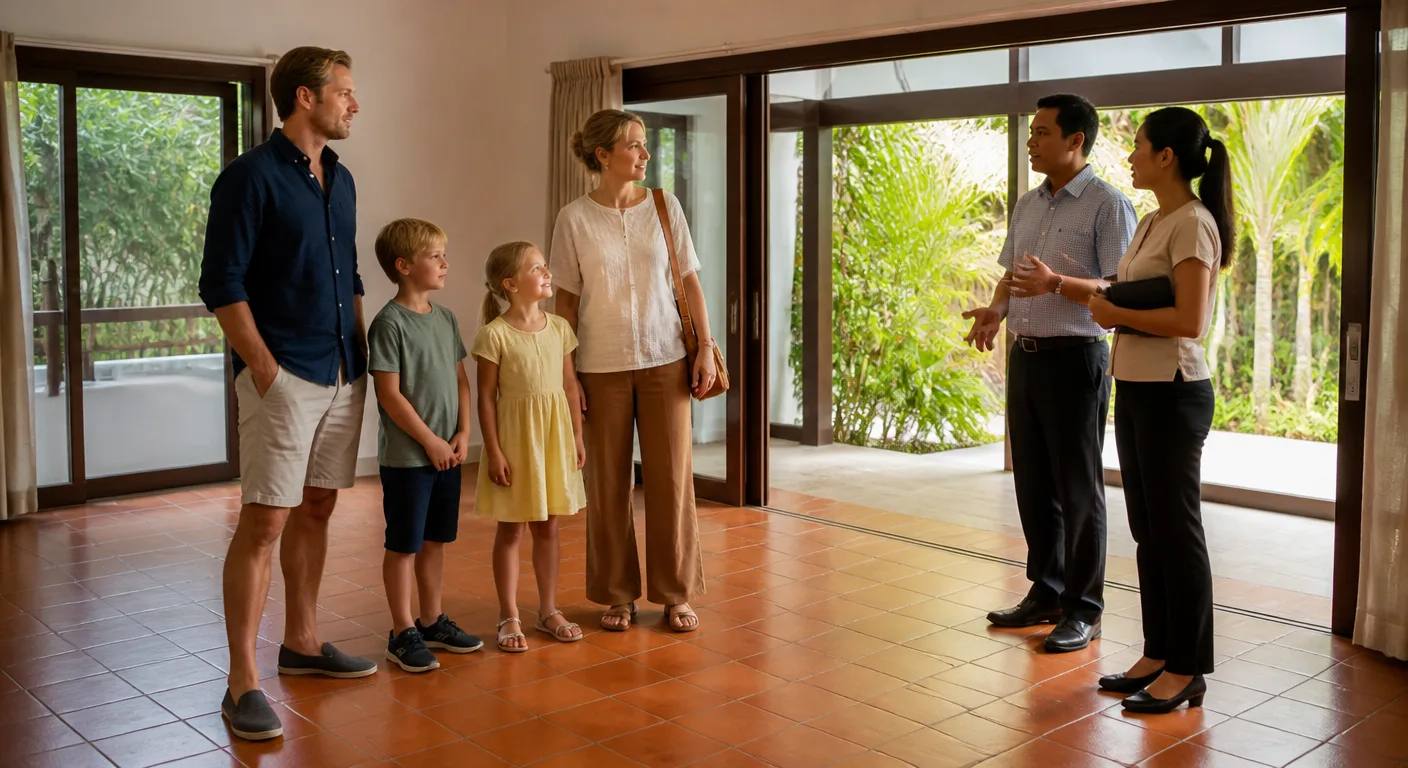
We hear the same line from families weighing Bangkok against Chiang Mai and Phuket: the capital is "the sensible choice, if less romantic." We have not lived in Bangkok full-time, but we have used its private hospitals and its private-candidate exam centers while based elsewhere in Thailand, and this guide is built on that experience plus our own published cost and healthcare figures. It is not a neighborhood guide — it is when the capital beats the other two, and when it does not.
- Bangkok costs the most on rent of the three cities.
- It has the deepest hospital and school choice, and the only real mass-transit system — BTS and MRT — among the three.
- It has its own haze season, running roughly November to March.
- It hosts the exam centers that homeschooling families elsewhere in Thailand have to travel to.
- It suits a family that wants services and infrastructure over space and slow pace.
When Bangkok beats Chiang Mai and Phuket
Bangkok is a good base for a family when the child's schooling, a medical need, or an exam calendar outweighs the cost of rent and the lack of a garden. It is the wrong base for a family on a tight budget, or one that wants a slower pace, nature within a short drive, and clean air year-round. Comparing Bangkok vs Chiang Mai vs Phuket on a single list makes the trade-off obvious.
| Your priority | Bangkok | Chiang Mai | Phuket |
|---|---|---|---|
| Rent (family-sized) | 25,000–40,000 THB/month (~$715–$1,145) | 18,000–28,000 THB/month | 25,000–38,000 THB/month |
| Transit | BTS/MRT plus Grab | Mostly car, scooter or Grab | Mostly car, scooter or Grab |
| Hospital and school choice | Deepest in the country | Good, smaller | Good, smaller, seasonal |
| Seasonal air | Haze roughly Nov–Mar | Burning season, see the guide | Cleaner most of the year |
| Space for children | Condo living, few gardens | More space, more houses | More space, closer to beaches |
| Flights | Main international hub | Domestic hub, fewer direct routes | Domestic hub, resort routes |
As of September 2026, family-sized rent runs about 25,000–40,000 THB a month (~$715–$1,145) in Bangkok, against 18,000–28,000 in Chiang Mai and 25,000–38,000 in Phuket, by our own published estimates. For a family doing IGCSE by private candidacy, the established centers cluster in Bangkok, and where IGCSE private candidates actually sit their exams in Thailand matters more than it looks on a map: a family based elsewhere had to plan travel and two hotel nights around a single sitting. For the neighborhood-level detail on the other two cities, we cover how Chiang Mai and Phuket compare for families separately.
Our own one-line verdict: Bangkok is ideal for a family that wants an ultra-served, international metropolitan experience; it is not the right pick for a family that wants a slow pace, nature within reach, and clean air all year.
What a Bangkok base costs
As of September 2026, a family of three should budget roughly 42,000–68,000 THB a month (~$1,200–$1,940), excluding school fees and insurance, for a Bangkok base. That range assumes a modest two-bedroom condo; rent climbs quickly the closer you get to the schools families actually want and to a train line.
| Line item | Bangkok range (THB/month) | Note |
|---|---|---|
| Family-sized rent | 25,000–40,000 (~$715–$1,145) | Two-to-three-bedroom condos run 25,000–60,000+ near good schools and stations |
| Electricity, moderate air conditioning | see the guide | Rises sharply in the hot and haze months |
| Groceries | see the guide | Varies with imported vs local shopping |
| Transport | see the guide | BTS/MRT plus occasional Grab |
| Approximate total (excl. school, insurance) | 42,000–68,000 (~$1,200–$1,940) | For a family of three |
The visa route usually decides the country before the base decides the city, so we would settle how the DTV visa works for a whole family before picking a neighborhood, not after. Lease terms and deposits in Bangkok work the same way as elsewhere in the country, and the practicalities — deposit size, break clauses, what a landlord expects — are covered in what renting long term as a family involves in Thailand.
Moving around with a child
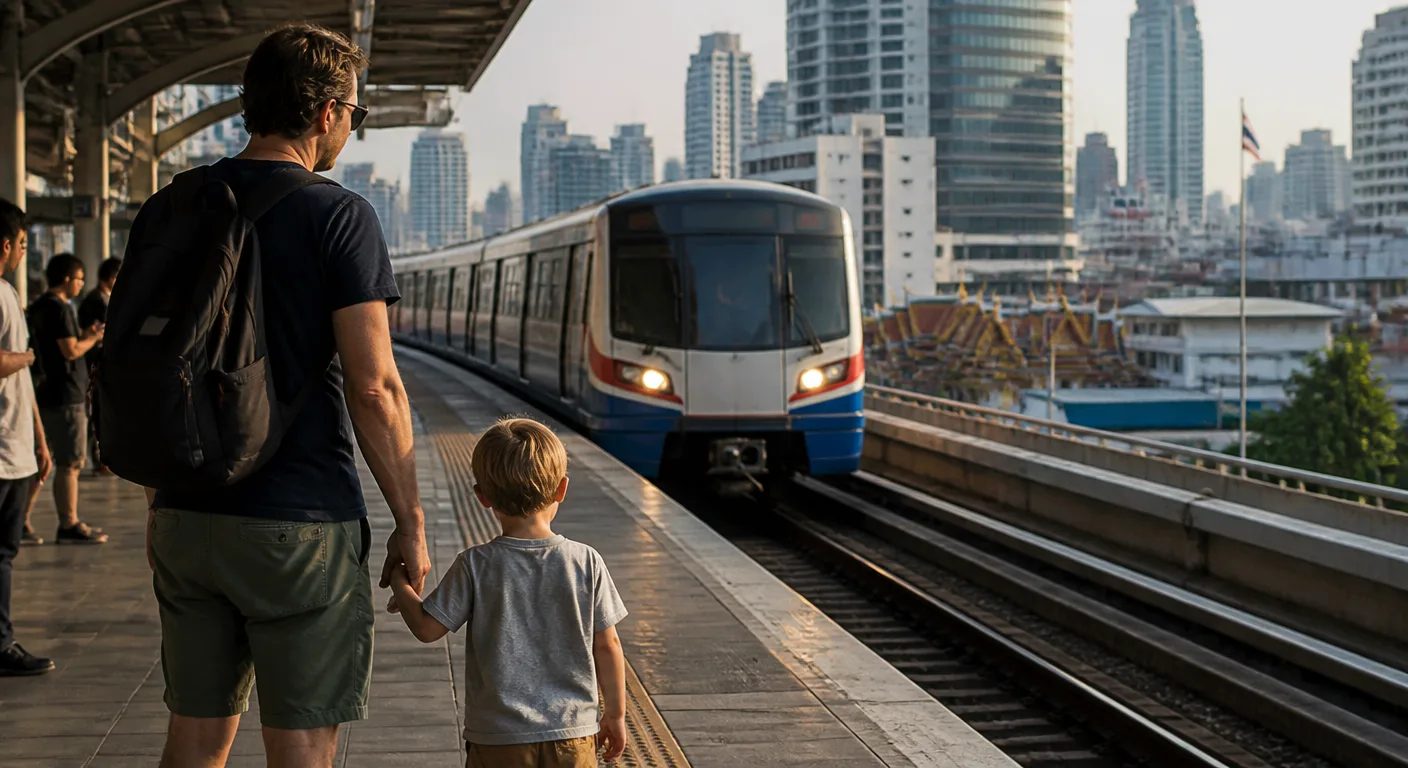
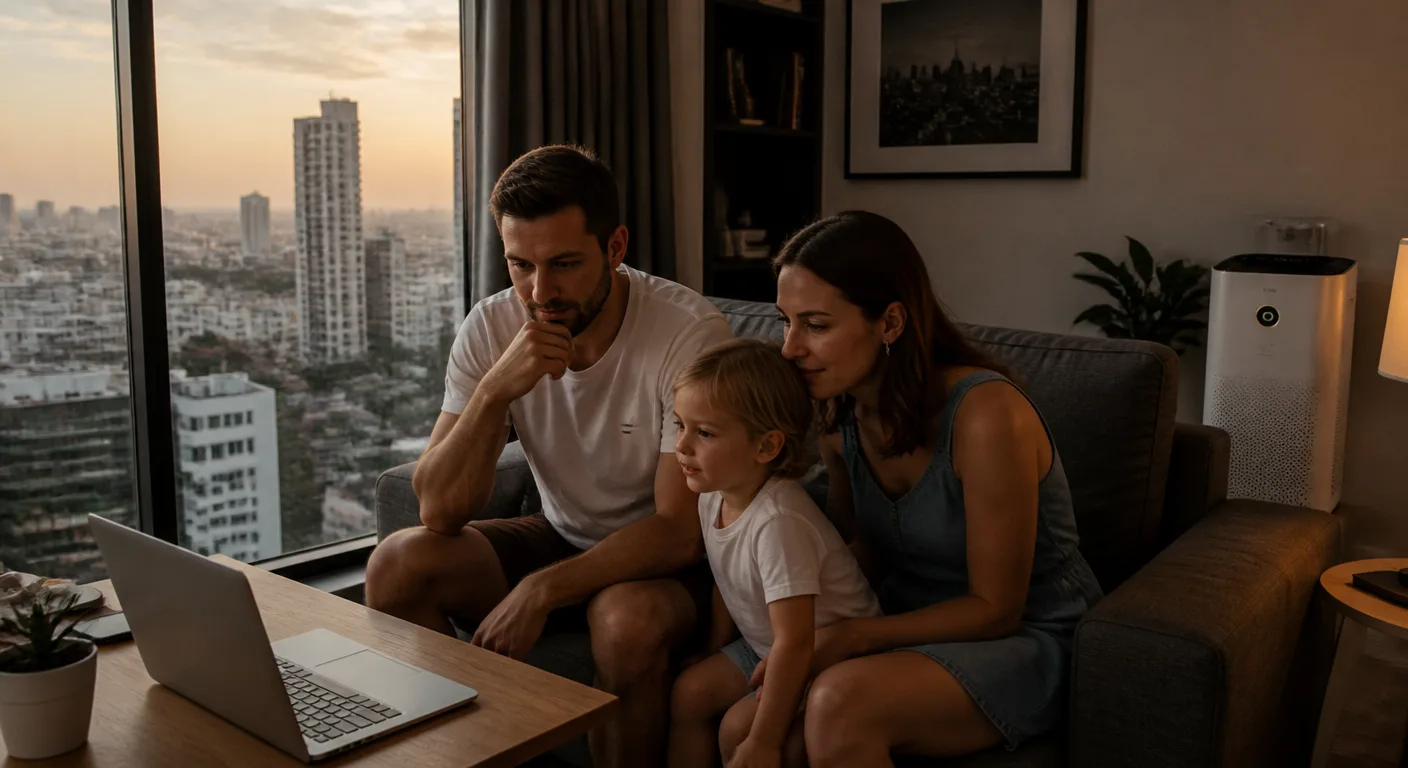
We mixed BTS and MRT with Grab for longer trips, and walked around the neighborhood for anything close. What surprised us was how poorly Bangkok's sidewalks work for a stroller — broken pavement, motorbikes parked across the path, and stretches with no curb cut at all — and how aggressively cold the air conditioning runs on the trains, to the point that we started carrying a light layer even in the hot season.
The BTS Skytrain adult fare matrix effective 1 November 2025 tops out at 65 THB (about $1.85) for the longest single journey, with a minimum fare of 17 THB. Children under 90 cm travel free, but that is a rule worth checking live before you rely on it, since fare rules change. The fare card itself is a stored-value card you top up, not a pass, so budgeting for it is straightforward once you know the ceiling.
Pro-tip: choose the home by walking distance to a station, not by the map distance to the school. The last kilometer on foot, in the heat, with a child, is what actually determines whether the commute works.
Air, heat and the haze season
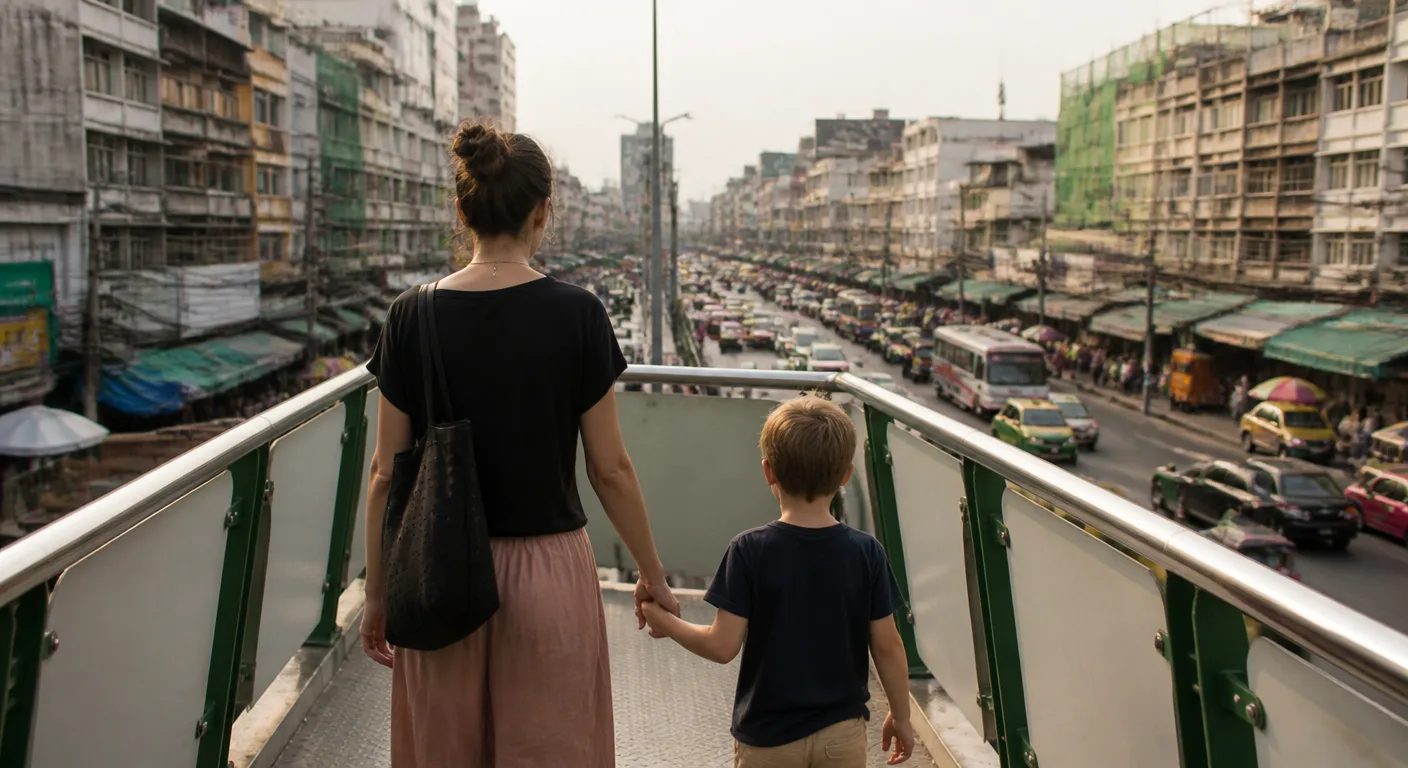
Bangkok is not free of a haze season, though it is not the same phenomenon as Chiang Mai's burning months. Roughly November to March, PM2.5 rises above Thailand's daily standard on a meaningful number of days, and that has a direct effect on lease timing and on what a family with a child does at home.
Thailand's Pollution Control Department reported that Bangkok's average PM2.5 fell from 33 to 28 micrograms per cubic metre between 1 November and 8 March, comparing the 2025-26 season to the previous one, and that the number of days above the air-quality standard fell from 65 to 29 over the same window — figures we take from the Pollution Control Department's 2025-26 season figures as reported by Khaosod English. The PCD's director still warned that PM2.5 could reach the orange level on some days during the seasonal transition. Thailand's daily standard is 37.5 micrograms per cubic metre as a 24-hour average, in effect since 1 June 2023.
We ran air purifiers at full power at home during that season, wore FFP2 masks outdoors, and always kept an escape to the southern islands ready for the worst peaks. Checking the live monitor at AirBKK's Bangkok air quality report before signing a lease, rather than relying on the seasonal average, is the practical habit we would recommend: an improving yearly average still hides bad individual days, and a January lease signed on a clear day can turn out to sit in a pocket that reads worse than the city average all season. Chiang Mai's burning season runs later, roughly February to April, and is covered in the two-city comparison rather than repeated here.
Warning: the seasonal average hides bad days. If your child has asthma or another respiratory condition, get a doctor's advice before committing to a Bangkok lease during haze season; this is not medical advice.
Hospitals and clinics
We used Bangkok Hospital for routine pediatric check-ups and minor health mishaps. Beyond that, our own bills from a Bangkok stay show what a private visit actually costs: a pediatric sick visit with medicine at Samitivej Chinatown Hospital came to 2,120 THB (about $61), a pediatric well-child visit was 800 THB (about $23), and an adult GP visit at a private clinic was 1,000 THB (about $29).
| What we went in for | Where | What we paid (THB) |
|---|---|---|
| Pediatric sick visit with medicine | Samitivej Chinatown Hospital | 2,120 (~$61) |
| Pediatric well-child visit | Samitivej Chinatown Hospital | 800 (~$23) |
| Adult GP visit | Private clinic, Bangkok | 1,000 (~$29) |
Samitivej runs a separate Samitivej International Children's Hospital with interpreters and international patient coordinators, and Bumrungrad International Hospital's Children's Center states Joint Commission International accreditation and describes 24/7 pediatric care from newborns through adolescents, including cardiology, neurology, infectious disease and surgery specialists. We are not ranking these against each other or against Bangkok Hospital — we have not used all three for comparable cases — but the depth of specialist pediatric care on offer is the strongest single argument for basing a family in the capital. For a fuller picture of what these bills add up to over a year, see what private hospital care in Thailand really costs a family.
Pro-tip: before choosing a hospital, ask whether its pediatric department treats your child's specific age and condition, and whether it holds a direct-billing arrangement with your insurer. Both hospitals above publish a children's service, but coverage of ages and conditions differs between them.

Where we lived, and why we left
We lived in Silom/Sathorn, chosen for its convenience and the density of services around it, and left because the cost of living there was high relative to what we were getting. We also lived in Ari, chosen for its residential feel and its cafes, and left to get away from the dense traffic in that part of the city. Neither move was about the area being wrong in itself — both track the trade-offs in the tables above: Silom/Sathorn sits at the expensive end of the Bangkok rent range, and Ari's traffic is part of the same congestion that makes walking distance to a station, not distance on a map, the number that matters for a family. We are not naming a "best area," because the only areas we can speak to firsthand are these two.
Frequently asked questions
Is Bangkok a good place to live with kids?
Yes, for families that need hospitals, school choice, transit and exam centers close by; less so for families that need space and low rent. Air quality is seasonal rather than a year-round problem, so the answer depends on what the family prioritizes and when it plans to move.
Is Bangkok cheaper than Phuket?
Not really. By our published ranges, family-sized rent runs about 25,000–40,000 THB a month in Bangkok against 25,000–38,000 in Phuket — the two overlap more than they differ, so cost alone rarely decides between them.
Does Bangkok have a burning season like Chiang Mai?
Not burning in the same sense, but Bangkok has its own PM2.5 season running roughly November to March. The Pollution Control Department reported 29 days over the air-quality standard between 1 November and 8 March in the 2025-26 season.
How much does the BTS cost?
The adult Rabbit-card fare matrix effective 1 November 2025 tops out at 65 THB (about $1.85) for the longest journey, with a 17 THB minimum. Children under 90 cm are said to travel free, but check the current rule before relying on it.
Can I live comfortably on US $2,000 a month in Thailand as a family?
Not in Bangkok. Our published range for a family of three is 42,000–68,000 THB a month (about $1,200–$1,940) before school and insurance, so $2,000 covers the total only at the lower end and with no cushion for fees.
Where do IGCSE private candidates sit exams in Thailand?
The established private-candidate centers cluster in Bangkok, including the British Council. Families based in Chiang Mai or Phuket typically travel to the capital and book accommodation around the sitting.
What is the best area of Bangkok for a family?
We do not rank areas we have not lived in ourselves. Choose based on walking distance to a station, proximity to the hospital you would use, and the length of the school run, rather than on general reputation.
Our checklist before choosing Bangkok
Before signing anything, we would confirm the walking distance from the home to a station, check the live air-quality monitor for that block rather than trusting the seasonal average, confirm which hospital's pediatric department actually treats your child's age, price the rent against the published range above, and check exam-center dates if the family is homeschooling toward IGCSE.
What surprised us most about Bangkok as a family was not any single cost or bill — it was the constant background presence of air pollution, and how completely traffic can derail a day's plans no matter how well it was scheduled.
Rents, fares and air-quality figures all move. Treat every number here as a September 2026 estimate, and let the live source — the fare matrix, the air-quality monitor, the hospital's own page — override this article when they disagree.
Sources
- https://www.bts.co.th/files/uploads/tickets/pdf/fare_matrix_Eff.1Nov25_Adult.pdf
- https://official.airbkk.com/
- https://www.khaosodenglish.com/news/2026/03/11/bangkok-past-pm2-5-crisis-stage-pollution-agency-says/
- https://www.samitivejhospitals.com/
- https://www.bumrungrad.com/en/centers/children-pediatric-health-care-surgery-center-bangkok-thailand
Written by Fabrizio Bestoso
Fabrizio Bestoso is a digital entrepreneur and the father of a family that lives and works on the move across Thailand, Asia, Spain and Middle East. He started Nomad Family Hub to turn the logistics his own family works through — the DTV visa, health insurance, multi-currency money, distance schooling, work — into step-by-step guides, each checked against official sources and against what actually happened.